































Solar and wind aren’t “alone” anymore — they found a new way to make energy coming from the sky, and it’s not what people think

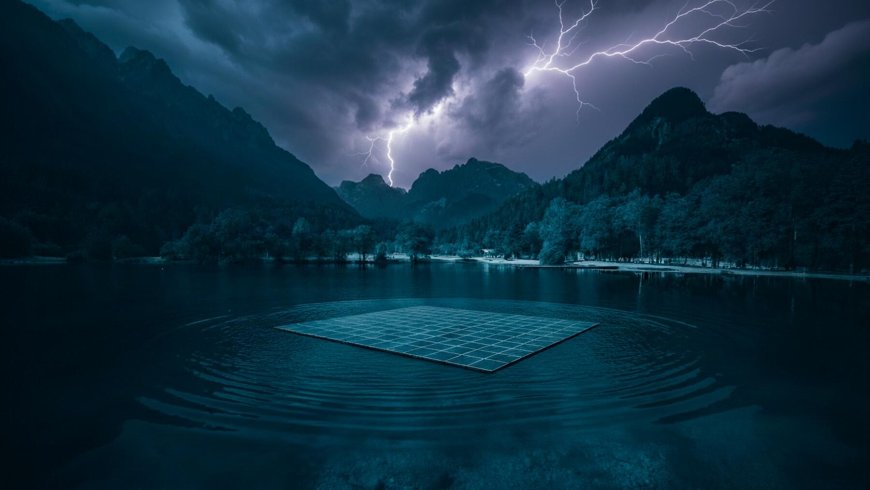
For years, clean energy felt like a closed club. If it doesn’t spin or shine, it doesn’t count. Solar gets the glory, wind gets the headlines, and everything else waits outside. That’s why this story sounds wrong at first. Something is now producing electricity without panels, without turbines, and without drama. It falls from the sky, nobody pays attention to it, and yet it might quietly change the rules.
When clean energy follows the same old script
Most renewable energy stories look familiar. Sunlight hits panels. Wind turns blades. It’s easy to explain, easy to picture, and easy to believe. Over time, this repetition made us assume the future would look exactly the same — just bigger and shinier.
That mindset created a blind spot. Nature doesn’t only move in straight lines or circles. It taps, hits, flows, and disappears again. And some of that motion has been ignored simply because it looked too small to matter.
The overlooked force we experience every day
There is something that touches cities, forests, lakes, and rooftops daily. It arrives without warning, leaves without a trace, and costs nothing. People complain about it, wait it out, or rush indoors because of it.
Most of the time, we see it as inconvenience, not opportunity. But physics doesn’t care how boring something looks. Movement is movement. And where there is movement, there is energy.
Why earlier ideas never worked out
Scientists didn’t ignore this force. They tried to use it. The problem wasn’t imagination — it was practicality. Early designs depended on stiff frames, metal parts, and fragile components.
They worked in labs. They failed outside. Too heavy. Too expensive. Too easy to damage. Nature kept winning, and the idea quietly faded into the background.
The breakthrough nobody expected
The turning point came when researchers stopped trying to control the force and instead built a system that cooperates with it. Less metal. Less structure. More flexibility.
By letting the environment do part of the work, the system became lighter, cheaper, and far more durable. Suddenly, something once seen as useless started making sense again.
What China has just revealed — and what it really uses
This is where China quietly stepped in.
Researchers at Nanjing University of Aeronautics and Astronautics developed a floating device called the W-DEG. Instead of standing against the weather, it floats on water and turns falling rain into electricity.
Each drop creates a brief electrical pulse. Not huge power — but enough. The system is around 80% lighter and about half the cost of older designs, and it’s already been tested on Donghua Lake in Nanjing, staying stable under real conditions.
Why this isn’t about replacing solar or wind
This invention won’t power cities. And that’s the point. It’s made for small, quiet jobs: sensors, remote stations, low-power devices in places where panels and turbines don’t belong.
Solar and wind aren’t being replaced. They’re being joined.
Sometimes, the future of energy isn’t louder or bigger. Sometimes, it’s the thing falling from the sky that everyone forgot to look at.
What's Your Reaction?
 Like
0
Like
0
 Dislike
0
Dislike
0
 Love
0
Love
0
 Funny
0
Funny
0
 Angry
0
Angry
0
 Sad
0
Sad
0
 Wow
0
Wow
0