




























Scientists were studying the familiar Ring Nebula until they uncovered a massive iron structure as large as 470 million Earths

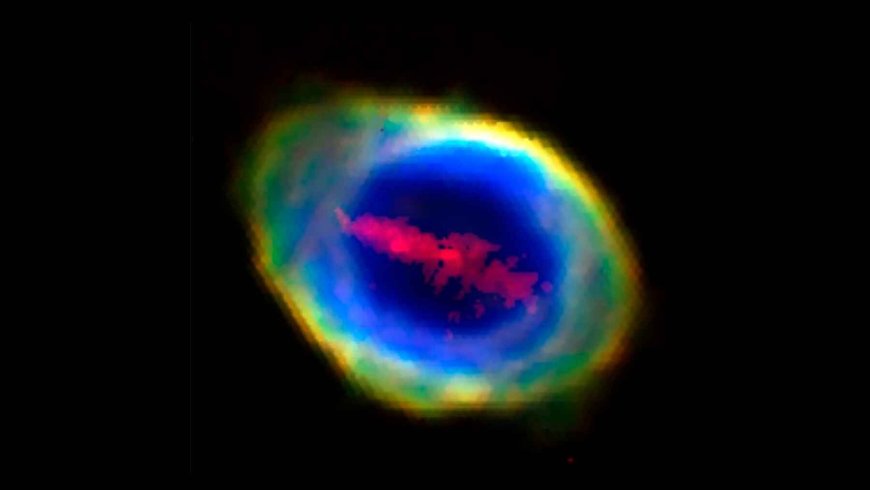
Astronomers have detected a massive space structure as large as 470 million Earths.
Our ability to study space has become a focal point in our evolution over the last 50 years or so. The iconic and stunning Ring Nebula left the astronomical community in a state of shock and awe, but recent findings of a massive iron structure have raised more questions than answers.
How was this huge celestial structure created in the deepest regions of space?
How are we developing new technology to study space and our planet
We have made remarkable leaps forward in space technology in recent years.
A recent joint project between the European Space Agency and the Chinese Academy of Sciences aims to capture the very first image of the interaction between the solar winds from the Sun and our planet’s magnetosphere.
And that’s just the start of the game-changing technology that has been developed over the past few decades.
The Vera Rubin Observatory has the largest camera ever produced for astronomy in history, enabling astronomers and cosmologists to capture images of deep space that boggle the mind of even the most experienced experts.
Technological progression has created a new era of space exploration and study
As a species, we have gazed at the stars in awe and wonderment as to what exactly is out there.
An ancient alien species that existed for millions of years before us? Odd massive space structures that have no clear point of origin? All these questions can be answered via our collective progression in technology.
The recent launch of the Artemis II Moon mission has amazed the world as we head back to the Moon for the first time in 50 years.
And as the public’s attention is drawn back to space exploration, we have new technologies that the Apollo astronauts could only have dreamed of. To put it simply, the computational power that allowed Apollo to reach the Moon was roughly the same as that found in a modern toaster.
And the mysteries of space and all that’s out there are becoming that much easier to study in detail.
Recent studies of asteroids found in space have found that the building blocks for life existed in the cosmos long before the Earth was formed. Perhaps signalling that life existed in the universe long before we did.
A recent study led by the University College London has found a massive iron structure that beggars belief.
The iconic Ring Nebula has revealed a massive secret structure
The now iconic Ring Nebula is a famous planetary nebula located roughly 2,600 light-years away in the constellation Lyra.
Astronomers have found that it formed approximately 4,000 years ago when a star much like our own ejected its outer layers, leaving behind a huge white dwarf core in its place.
Space-based studies found that the universe is a violent place for life to develop. With astronomers mapping over 300 “scars” across the cosmos in recent months.
This year, we have made several astonishing discoveries about celestial objects in space with no clear origin or explanation. And the recent discovery of a linear cloud of ionized iron atoms that stretches across the Ring Nebula has raised more questions for science to explain.
A huge iron structure the size of millions of Earths has been found in the Ring Nebula

Researchers utilized the WEAVE instrument at the William Herschel Telescope to map the chemical composition of the Ring Nebula and found a huge “iron bar” that is roughly the size of 470 million Earths. The bar is approximately 3.7 trillion miles long.
This challenges previously established theories of how nebulae form in space.
So while the James Webb Space Telescope is unraveling hidden mysteries in space, this discovery has painted the universe in a very unfamiliar shade. Some have theorized that the origin of this “iron bar” most likely comes from the vaporized remains of a rocky planet from when the star died.
What's Your Reaction?
 Like
0
Like
0
 Dislike
0
Dislike
0
 Love
0
Love
0
 Funny
0
Funny
0
 Angry
0
Angry
0
 Sad
0
Sad
0
 Wow
0
Wow
0