































Scientists lowered a camera into an active volcano beneath the Pacific until they captured, for the first time, how the Earth releases its energy

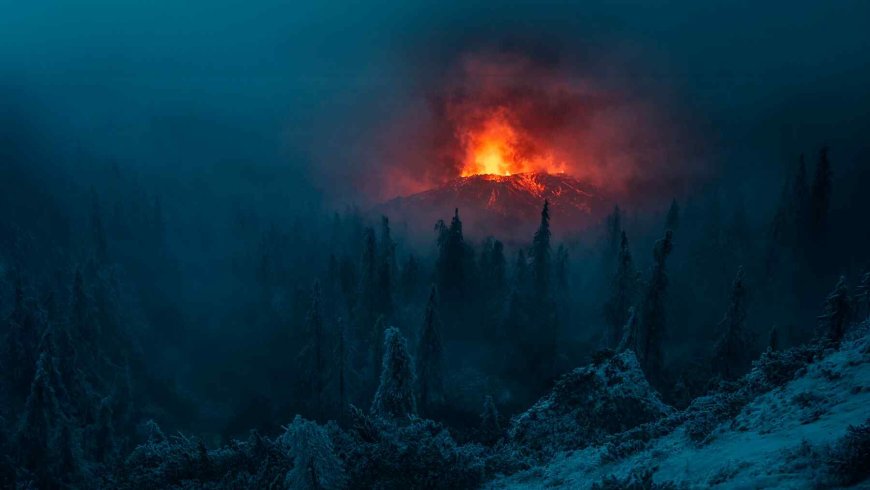
Scientists have captured how the Earth releases its energy.
The number of mysteries regarding the Earth is getting significantly less in recent years as technology advances. And when researchers lowered a camera deep beneath an active volcano in the Pacific Ocean, they captured for the very first time how our planet releases its energy.
What led to this remarkable feat of Mother Nature being filmed for the first time?
How the Earth continuously reshapes itself over time is amazing
Our plant is far from just a static rock in the cosmos; it is in a constant state of evolution, much like us.
The Earth’s crust is not simply one massive, solid piece; it is a great conveyor belt of tectonic plates that are never settled and are constantly moving. In some parts of the ocean, magma rises to create new ocean floor, while in other parts, the older crust is forced back into the hot interior of the planet.
Some of the most recognizable features in certain parts of the world are a result of our planet’s never-ending evolution.
Such as the fjords in Norway. These were created when massive ice glaciers acted like sandpaper and carved out huge valleys and flattened mountain ranges over thousands of years.
Life on this third rock from the Sun is nothing if not adaptable
Not only is our planet constantly adapting as its environment and chemistry are altered over thousands of years, but animal life is displaying remarkable behaviors too.
Such as the recent discovery made by a marine ecologist that saw sperm whales protecting unrelated mothers during the birthing process.
Some changes are good for the planet, while others exhibit the disastrous effects we have had on the Earth. The never-ending boiling pot of life that is the Earth is like a toddler on a sugar rush, never standing still and in constant, almost blurry motion.
Many of the most iconic and beautiful parts of the world have been ravaged by pollution, mostly caused by us humans.
This paradox of protecting the very planet we live on and progressing as a society has had a few unforeseen effects on the world, such as an iconic dam in South Africa that has slowly been polluted from runoff over the last few decades.
But how exactly is the planet releasing the unfathomable amounts of energy it has stored away?
A study, “Voluminous Inflated Lobate Flows on the Distal Rift Zones of Axial Seamount, Juan de Fuca Spreading Ridge,” published in Geochemistry, Geophysics, Geosystems, has filmed the process recently.
Seven minutes that will change how you see our planet forever
The Monterey Bay Aquarium Research Institute (MBARI) has played a vital role in developing a better understanding of the alien world that exists deep beneath the surface of our oceans.
Filming odd and unexpected happenings beneath the ocean is becoming a more common occurrence in recent years.
But when the team from MBARI and their collaborators lowered a camera, specifically an AUV (Autonomous Underwater Vehicle) beneath the Pacific Ocean surface, they ended up filming how the planet releases its energy, for the first time ever, we might add.
They used the AUV to film and document massive, 1,200-year-old lava flows on the seafloor.
They revealed through this process how an underwater volcano releases energy via the “inflated” lobe formation. The research is significant for us as a species because it is the first time that we have gotten a detailed look at how these enormous underwater volcanic structures are formed.
While above-ground volcanoes force the local population into a state of panic, scurrying to get to safety, this underwater “film shoot” has shown how the planet releases the vast amounts of energy it has stored away for thousands of years.
What's Your Reaction?
 Like
0
Like
0
 Dislike
0
Dislike
0
 Love
0
Love
0
 Funny
0
Funny
0
 Angry
0
Angry
0
 Sad
0
Sad
0
 Wow
0
Wow
0