
























Scientists Found Strange “Modern” Structures on the Arctic Seafloor That Should Not Physically Exist

On the floor of the Canadian Beaufort Sea, something is growing in the dark. Not slowly, not quietly, but in massive ridges of ice that blister upward through the sediment, then collapse into sinkholes the size of city blocks. The seafloor here looks like it has been detonated from below.
It took twelve years of robotic surveys, five expeditions, and a descent into newly formed craters before researchers understood what they were actually looking at. What they found there overturned a foundational assumption about the Arctic.
The ice forming on this seafloor is not ancient. It is being created right now.
Not a Relic — a Live Process
For decades, scientists assumed that all submarine permafrost was frozen in place since the last ice age, slowly thawing as the planet warmed. The discovery published in the Journal of Geophysical Research by MBARI geologist Charlie Paull and an international team shows that picture is wrong in a fundamental way.
Deep beneath the seafloor, ancient permafrost is melting. The water it releases, brackish and chemically distinct, migrates upward. When it approaches the near-freezing seafloor, sitting at roughly -1.4 degrees Celsius, it refreezes. That ascending brackish groundwater builds ice layers under the sediment, pushing the seafloor upward into mounds. Seawater seeps into the blisters, melts the ice from above, and the ground collapses. Then the cycle starts again.
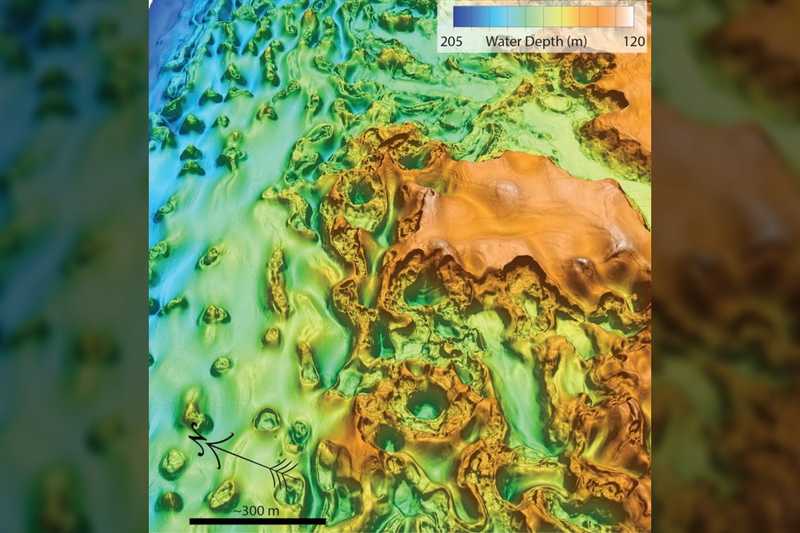
“Our work shows that permafrost ice is both actively forming and decomposing near the seafloor over widespread areas, creating a dynamic underwater landscape with massive sinkholes and large mounds of ice covered in sediment,” Paull said. The driver is not atmospheric warming but geothermal heat rising slowly from within the Earth, a process far older and slower than human-driven climate change.
Inside the Craters
The seafloor here first attracted attention in 2010, when Canadian researchers mapped the region and found terrain unlike anything documented nearby. The Monterey Bay Aquarium Research Institute began high-resolution surveys in 2013, deploying autonomous underwater vehicles capable of resolving the seafloor down to a one-meter grid. Over twelve years and five survey campaigns, 65 newly formed craters appeared where none had been before. The largest was the size of a city block of six-story buildings.
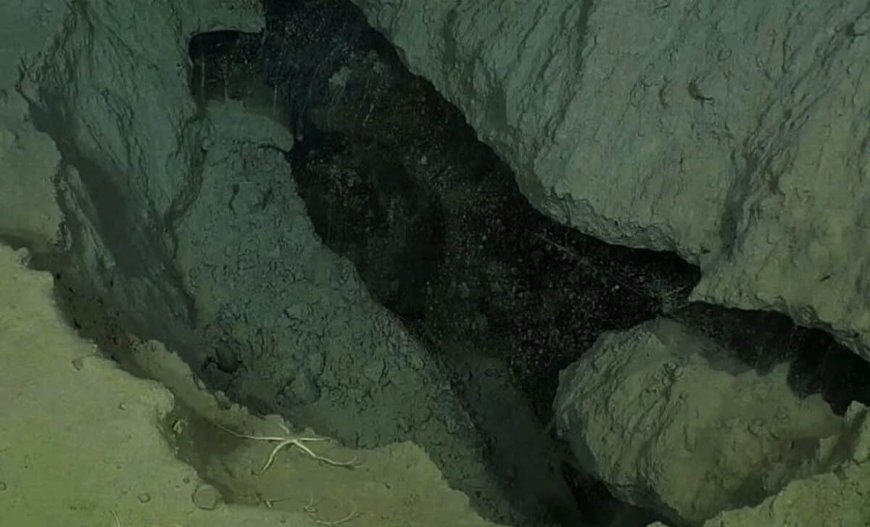
In 2022, the team returned aboard the Korean icebreaker Araon, operated by the Korea Polar Research Institute. They used MBARI’s mapping AUVs to locate the freshest craters, then sent a MiniROV down to look inside. The footage showed dark ice layers cutting diagonally through sediment walls, with crumbled material piled beneath each exposed face. Brittle stars moved across the rubble below.

Isotopic analysis confirmed what the images suggested. The ice had not been there since the Pleistocene. It came from groundwater carrying a chemical signature distinct from both seawater and glacial ice, a mechanism that had never been described before.
A Landscape That Cannot Be Trusted
What makes this finding more than a geological curiosity is what it means for everything built on or near that seafloor. Pipelines, communication cables, and subsea infrastructure in the Arctic are sited using permafrost surveys designed to find the ancient, static permafrost scientists thought they were dealing with. Those methods cannot detect the near-seafloor ice formations Paull’s team has now identified.
“This discovery means that the techniques we’ve previously used to locate submarine permafrost don’t work for the types of near-seafloor ice that we recently discovered exist in the Arctic,” Paull said. “We now need to revisit where permafrost may exist under the Arctic shelf.” A seafloor that is actively forming mounds and collapsing into sinkholes on decadal timescales presents a different engineering problem than one assumed to be slowly and uniformly degrading.

The implications extend beyond this one stretch of the Beaufort Sea. The process requires only that bottom-water temperatures sit below zero Celsius and that ancient permafrost exists at depth, conditions present across wide areas of the Arctic shelf.
What the Surveys Recorded
MBARI has worked in this region since 2003, part of an ongoing international collaboration that gained new access as retreating Arctic sea ice opened navigation routes. The surveys conducted over the following two decades document a seafloor in rapid transformation. Craters appear between surveys. Mounds rise where flat ground was recorded before. The terrain rearranges itself continuously below the surface.
The 2022 expedition brought together researchers from the Korea Institute of Geoscience and Mineral Resources, the Geological Survey of Canada, and the U.S. Naval Research Laboratory. It was designed specifically to follow up on earlier crater discoveries with direct visual observation, something no prior expedition had managed at this resolution and in this location.
The seafloor ice formations found inside those craters were the confirmation Paull’s team needed. Not remnant ice. Not ancient ice. Ice that formed after humans had already begun surveying this seafloor.
The Assumption That No Longer Holds
“We previously believed all underwater permafrost was leftover from the last ice age, but we’ve learned that Arctic submarine permafrost is also actively forming and decomposing on the modern seafloor,” Paull said.
That revision matters because submarine permafrost maps are used to assess methane release risk, plan infrastructure, and model how the Arctic shelf will respond to continued warming. If those maps are based on detection methods that miss an entire category of near-seafloor ice, the baseline they establish is incomplete.
The research was funded by the David and Lucile Packard Foundation, the Korean Ministry of Ocean and Fisheries, the Geological Survey of Canada, and the U.S. Naval Research Laboratory.
Enjoyed this article? Subscribe to our free newsletter for engaging stories, exclusive content, and the latest news.
What's Your Reaction?
 Like
0
Like
0
 Dislike
0
Dislike
0
 Love
0
Love
0
 Funny
0
Funny
0
 Angry
0
Angry
0
 Sad
0
Sad
0
 Wow
0
Wow
0