































NASA Finally Cracks the Mystery of Bennu’s Rocky Surface, Revealing What Lies Beneath

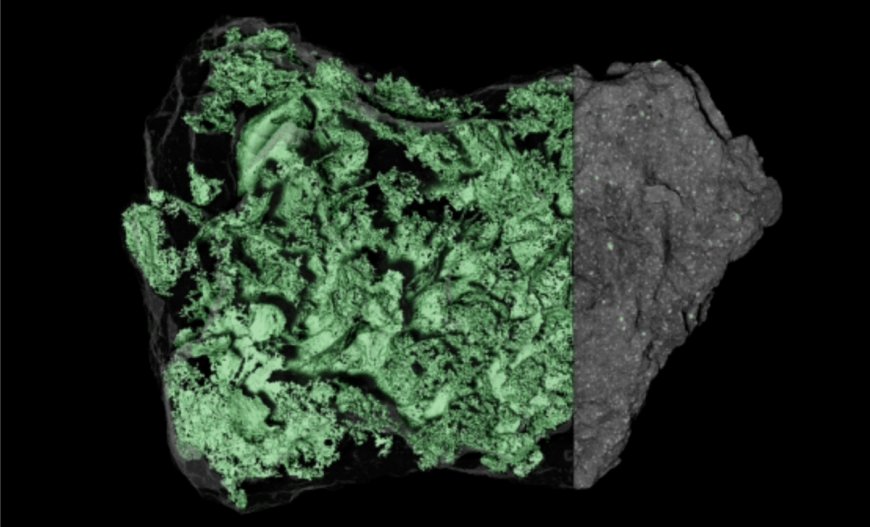
NASA’s OSIRIS-REx mission, scientists have unlocked the mystery behind the jagged, boulder-covered surface of asteroid Bennu. The new findings, published in Nature Communications, overturn long-standing expectations and offer a fresh perspective on how we understand asteroid composition and behavior. By using advanced technologies like X-ray computed tomography (CT) scans, researchers discovered that Bennu’s boulders are riddled with cracks, a critical factor in their unexpected thermal properties. This breakthrough not only deepens our knowledge of Bennu but reshapes how we study distant celestial bodies.
The Surprising Discovery of Bennu’s Surface
When the OSIRIS-REx spacecraft arrived at Bennu in 2018, scientists were faced with an unexpected challenge. “When OSIRIS-REx got to Bennu in 2018, we were surprised by what we saw,” said Andrew Ryan, a scientist with the University of Arizona’s Lunar and Planetary Laboratory. The mission team had expected Bennu to contain some boulders, but they anticipated regions with smooth, fine regolith, easy to collect for analysis. Instead, Bennu appeared to be entirely covered in large, jagged rocks, making the task of sample collection far more difficult than expected.
The initial findings puzzled scientists, as they didn’t align with previous observations of the asteroid. In 2007, data from NASA’s Spitzer Space Telescope suggested that Bennu’s surface would resemble that of a sandy beach, a place where fine, easily collected material would abound. Instead, the reality of Bennu’s surface contradicted these predictions. The large boulders should have shed heat more slowly, yet thermal measurements from OSIRIS-REx initially suggested otherwise.
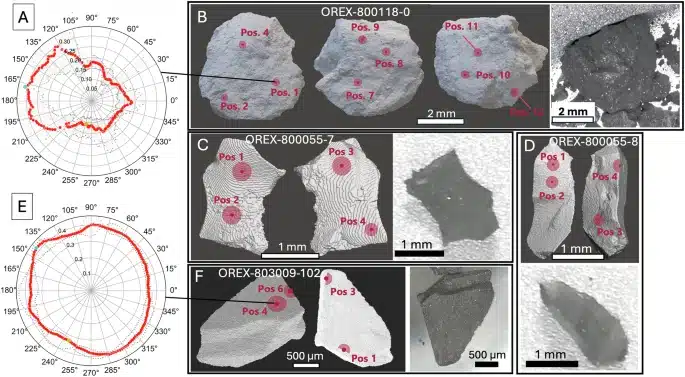
Credit: Nature Communications
The Key to the Puzzle: Cracks in the Rocks
The breakthrough came when OSIRIS-REx scientists began analyzing the asteroid’s surface material back on Earth. Ryan and his team found that Bennu’s boulders were not only porous but also riddled with cracks. “That’s when things became really interesting,” Ryan explained. Using advanced laboratory techniques, the team examined rock particles collected from Bennu’s surface. Their analysis revealed that the boulders’ thermal properties were much more complex than initially thought, and the cracks inside the rocks played a crucial role in the way heat was lost from the asteroid’s surface.
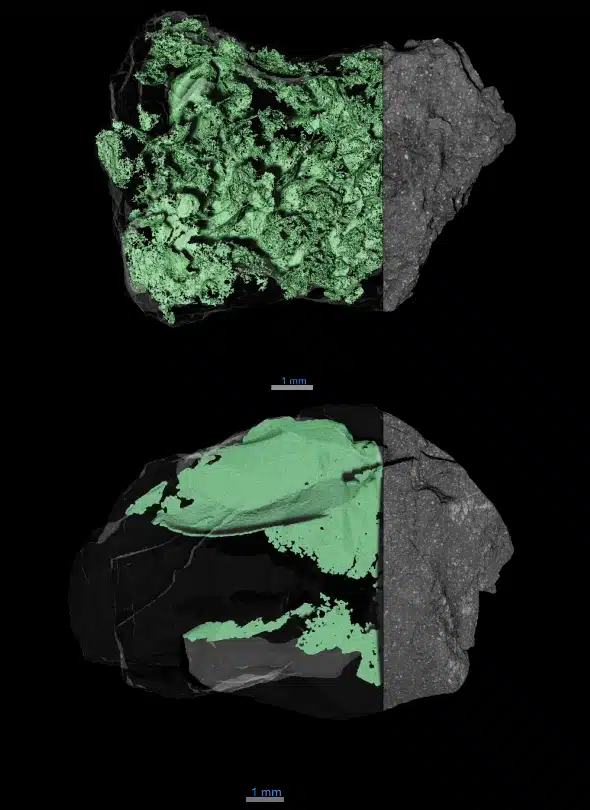
This new understanding was confirmed through a variety of tests, including X-ray computed tomography (XCT) scans. The method allowed scientists to look inside Bennu’s rocks in 3D, providing critical insights into their structure without damaging them. “X-ray computed tomography allows us to look at the inside of an object in three dimensions, without damaging it,” said Scott Eckley, a NASA Johnson X-ray scientist and study co-author. The use of this technique was pivotal in confirming that the cracks within the rocks were essential in explaining their thermal behavior.
Groundbreaking Technologies Aid Asteroid Study
To further investigate Bennu’s material, the team employed an innovative technique known as lock-in thermography, which allowed them to analyze heat diffusion in samples from Bennu. This technique, developed at Nagoya University in Japan, helped the researchers better understand how heat flows through the asteroid’s rocks. By simulating the heat transfer at the scale of Bennu’s boulders, the team was able to match their laboratory measurements with those made by the spacecraft.
Nicole Lunning, lead OSIRIS-REx sample curator at NASA’s Johnson Space Center, described the process of working with Bennu’s samples. “The sample goes into its own ‘spacesuit,’ gets a CT scan, and then comes back to its pristine environment, all without having any exposure to the terrestrial environment,” she said. This careful handling ensured that the samples remained uncontaminated, preserving their integrity for analysis.
A New Era of Asteroid Research
This study, published in Nature Communications, represents a major leap forward in our understanding of asteroids and their complex behaviors. Ron Ballouz, a scientist at Johns Hopkins University, emphasized the importance of this work in transforming how scientists interpret asteroid data. “We can finally ground our understanding of telescope observations of the thermal properties of an asteroid through analyzing these samples from that very same asteroid,” Ballouz said.
This discovery will have far-reaching implications for future space missions, especially as NASA plans for more detailed exploration of other asteroids. Understanding how heat behaves on rocky bodies like Bennu will be critical for designing future spacecraft and landing systems, allowing scientists to study distant worlds more effectively.
Enjoyed this article? Subscribe to our free newsletter for engaging stories, exclusive content, and the latest news.
What's Your Reaction?
 Like
0
Like
0
 Dislike
0
Dislike
0
 Love
0
Love
0
 Funny
0
Funny
0
 Angry
0
Angry
0
 Sad
0
Sad
0
 Wow
0
Wow
0