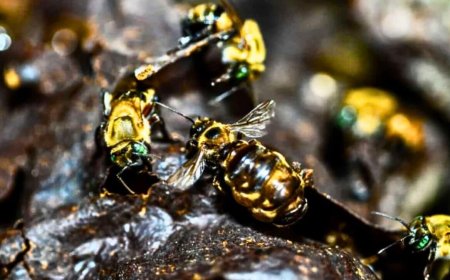























For the First Time in Legal History, a Government Has Given Insects the Legal Right to Live, Thrive, and Sue Humans in Court


Most legal systems treat insects as property, pests, or simply ignore them. Late last year, two municipalities in the Peruvian Amazon broke that pattern. Satipo and Nauta passed ordinances recognizing native stingless bees as legal subjects with defined rights. No government anywhere had previously granted legal personhood on an insect species.
The ordinances decree that these small black bees of the Amazon have the right to exist, to flourish in a healthy environment, and to be defended in court. A company, agency, or individual that destroys colonies through deforestation, pesticide spraying, or construction can now be sued on behalf of the bees themselves. Constanza Prieto, Latin America program director at the Earth Law Center, said the legal language recasts these pollinators as “rights-bearing subjects” instead of invisible service providers.
The ordinances read like a bill of rights for a wild pollinator. Stingless bees hold the right to maintain healthy populations, to live in clean and intact habitat with stable climate conditions, and to regenerate their natural cycles. Courts must now weigh damage to the species and the forest, not only losses measured in human terms.
A Pollinator That Anchors the Amazon
Stingless bees are far older than the familiar European honeybee. Roughly half of the world’s 500 known species live in the Amazon basin. Scientists have catalogued at least 175 native stingless bee species in Peru, a figure that almost certainly undercounts the true diversity. These insects pollinate about 80 percent of tropical plant species, including crops that travel far beyond the rainforest: cacao, coffee, and avocados all lean heavily on them.

The Eco Jurisprudence Monitor records that Nauta’s ordinance established the bees’ fundamental right to exist and flourish without pollution, habitat loss, or climate change blocking their survival. The measure rests on a 2024 reform in Peru’s Congress that placed stingless bees under formal state protection as part of the country’s biological heritage.
Before that national law, only European honeybees received legal recognition. The municipal ordinances go a step further: they grant enforceable rights rather than merely shielding the insects from harm.
Medicine, Tradition, and a Scientist’s Discovery
The push for legal personhood did not begin in a law office. Chemical biologist Rosa Vásquez Espinoza and her team at Amazon Research Internacional analyzed honey that Indigenous families were using as medicine during the pandemic. The samples revealed hundreds of bioactive molecules with antibacterial, anti-inflammatory, antioxidant, and possible anti-cancer properties.
Those lab results confirmed what Indigenous healers had said for generations. Among the Asháninka and Kukama-Kukamiria peoples, stingless bees appear in stories, songs, and ceremonies. They are not treated as livestock. Asháninka leader Apu Cesar Ramos explained that within the stingless bee lives traditional knowledge handed down from grandparents and bound to the rainforest.

Before research began, the project team created a Biocultural Community Protocol. The document sets rules for third-party access to genetic resources and traditional knowledge about meliponiculture, so that Indigenous communities keep control over their own wisdom and decision-making.
Why a Local Law Became Necessary
The ordinances answer a cascade of documented threats. Deforestation removes nesting trees. Land conversion for cattle and crops erases foraging grounds. Pesticides poison colonies. Climate disruption scrambles the flowering cycles the bees depend on, while extreme floods and droughts drive up colony mortality.
Africanized honeybees, which are more aggressive, now compete for and seize nest sites that stingless bees have used for millennia. Indigenous elders who once walked half an hour to locate a hive now walk for hours with no certainty of finding one. Families have started to leave traditional Amazonian beekeeping behind because keeping colonies alive has grown too difficult and the economic return too uncertain.

Satipo and Nauta must now act. The ordinances require reforestation in degraded areas, strict pesticide and herbicide controls, restoration of native flora, climate adaptation plans, and sustained scientific monitoring. The project team has already begun mapping 150,000 hectares of Amazonian forest and documenting traditional beekeeping methods across the region.
Ripples Beyond the Amazon
Peru’s legal shift has drawn attention from far beyond its borders. An Avaaz-backed petition has gathered hundreds of thousands of signatures urging the national government to extend these Rights of Nature protections nationwide. Environmental law groups in other countries are studying the Peruvian model as a template for safeguarding wild pollinators at home.
Earth Law Center has placed the Declaration of Rights for Native Stingless Bees at the center of its wider Amazon protection work. The organization practices what it calls Earth Law: a legal philosophy that treats nature as having intrinsic value and interconnected rights, not as property managed for human benefit.

The stingless bee ordinances join a small but growing body of Rights of Nature decisions worldwide. Colombian courts ordered bee protections in 2018. Brazil enacted legislation to shield stingless bees from certain pesticides. Yet no previous legal instrument had declared that a specific insect species holds the right to exist, thrive, and receive legal representation in court.
Granting legal standing to a bee will not, on its own, stop deforestation or stabilize the climate. But the ordinances turn the legal spotlight toward the pollinators that sustain forests and food systems. They also leave behind a question that other governments may find difficult to set aside: if a stingless bee can have rights, what else in the natural world deserves a voice.
Enjoyed this article? Subscribe to our free newsletter for engaging stories, exclusive content, and the latest news.
What's Your Reaction?
 Like
0
Like
0
 Dislike
0
Dislike
0
 Love
0
Love
0
 Funny
0
Funny
0
 Angry
0
Angry
0
 Sad
0
Sad
0
 Wow
0
Wow
0