



Convicted predators face lifetime barrier under GOP lawmaker’s sweeping victim protection bill

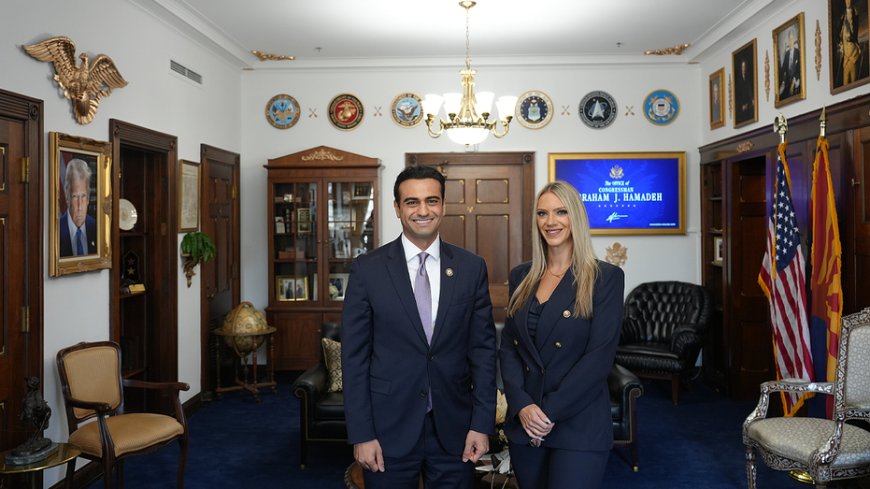
An Arizona congressman is putting convicted predators on notice after the House unanimously backed a bill designed to prevent abusers from dragging their victims back into court years after their crimes.
"Protect the victim. Stop the predator. End the revolving door," Rep. Abe Hamadeh, R-Ariz., wrote on X after the House passed Kayleigh’s Law.
"When a predator is convicted, the court issues a lifetime no-contact order," he added. "Not until probation ends. Not until some judge decides he’s ‘moved on.’ For life."
Hamadeh told Fox News Digital that the legislation would deliver permanent protection to survivors of federal sex crimes and violent felonies by requiring courts to issue lifetime no-contact injunctions against convicted offenders.
"This is a common-sense type of bill where we’re supporting victims, and we’re prioritizing victims over criminals," Hamadeh said.
The Kayleigh’s Law Act of 2026, introduced by Hamadeh as H.R. 8481, passed the House with unanimous support Monday and now heads to the Senate.
The legislation is named after Kayleigh Kozak, an Arizona mother of five who was sexually abused as a child and later forced to return to court when her abuser sought to have a no-contact protection lifted.
Hamadeh said Kozak was hauled back into court 13 years after the abuse, and then had to return again when the man made another attempt the following year.
CALIFORNIA DEMS TRIGGER OUTRAGE AFTER SIDING WITH CONVICTED CHILD SEX OFFENDERS IN SHOCKING VOTE
"Can you imagine that you have to sit across the room from this man?" Hamadeh said. "That’s something a victim should never have to do."
The federal bill would prohibit an offender from contacting the victim directly or indirectly for the rest of the offender’s life, even after prison, probation or supervised release ends.
"When you abuse a child, or you sexually abuse a child, or if you commit a violent offense against them, you should never have to interact with that person ever in their lives," Hamadeh said.
Kozak’s fight for permanent protections grew out of her own experience with Joshua Jacobsen, a former teacher and soccer coach who pleaded guilty to sexual abuse and luring a minor for sexual exploitation. Kozak was 12 years old and one of his students when the abuse occurred, according to FOX 10 Phoenix.
Jacobsen was sentenced to six months in jail and lifetime probation. Nearly two decades later, he asked a Maricopa County judge to end that probation, arguing that his conduct over the previous 18 years showed he had reformed and was ready to "move on," the outlet reported.
Kozak returned to court to oppose his request.
"I am living proof that he is capable of sexually harming children," Kozak told the court. "He consciously chose to violate me, and he was convicted of committing a dangerous crime against a child while he was in a position of power."
Jacobsen’s effort ultimately failed. A Maricopa County judge denied his request in June, citing probation violations that included unauthorized contact with children and breaches of chaperone restrictions, according to Arizona’s Family.
Jacobsen remains on lifetime probation under the supervision of Maricopa County Adult Probation.
Kozak celebrated the House vote on X, saying the country was "one step closer" to giving victims of heinous crimes the permanent protection they deserve.
PREP SCHOOL TEACHER FILMED SEX WITH STUDENT SHE WAS TUTORING: ‘NOT MY BEST THINKING’
"No victim should ever have to endure the hell I had to walk through," she wrote. "When I discovered protection wasn’t permanent, I knew it had to change."
Versions of Kayleigh’s Law have passed in Arizona and Wisconsin. Hamadeh said more than 1,000 Arizona survivors secured lifetime protection during the state law’s first year.
In a statement announcing the House vote, Hamadeh’s office said the legislation aims to end the "legal tug-of-war" that forces survivors to repeatedly face their attackers in court to maintain basic protections.
"Victims should never again have to fill out another form, sit across from their abuser, or look over their shoulder because the sentence ran out, and the system shrugged," Hamadeh said in a statement following the vote.
The issue became personal for Hamadeh long before he entered Congress.
SENATOR TIM SHEEHY: SOFT-ON-CRIME JUDGES NEED CONSEQUENCES. THE JAIL ACT DELIVERS
He met Kozak about five years ago while running for Arizona attorney general. Years later, as he campaigned for Congress, the two met outside an In-N-Out Burger, where he made her a promise.
"I told Kayleigh, I said, ‘Kayleigh, the moment I get to Congress, it’s going to be one of my first bills that I get done,’" Hamadeh recalled.
Kozak and her children later joined Hamadeh at the Capitol as the House approved the legislation.
"Promise made, promise kept," Hamadeh said. "To actually see it done has been really wonderful."
Hamadeh, a former prosecutor and Army veteran, said Kozak transformed the trauma she endured into a campaign that could protect millions of other survivors.
NEW YORK BILLS COULD ABOLISH LIFE WITHOUT PAROLE FOR SERIAL KILLERS AND COP KILLERS, CRITICS WARN
"She’s turned this tragedy into something that’s an inspiration to so many," he said. "From the moment it happened, it’s always been personal to me."
Asked about defendants’ due process rights, Hamadeh noted that the restrictions would apply only after a conviction.
"This is not about the due process beforehand," he said. "They ultimately have to be found guilty of a crime."
Once an offender has been convicted and sentenced, Hamadeh argued, that person should not be allowed to contact the victim or repeatedly summon the survivor back to court.
"The victim shouldn’t be re-traumatized over and over again," he said. "At that point, they should have no ability to contact the victim ever in their lifetime."
AOC OFFERS RARE PRAISE TO LATE SEN GRAHAM FOR BACKING AI PORN BILL NOW STALLED IN HOUSE
Hamadeh said his time as a prosecutor showed him how emotionally punishing the court system can be for survivors forced to revisit deeply personal trauma.
"You have to relive that over and over again," he said.
"Justice is not complete if the victim still lives in fear," Hamadeh said. "Arizona already closed that gap. It is time the federal government did the same."
The legislation now faces the Senate, where Sen. Mike Lee, R-Utah, is leading the effort to move it forward, according to Hamadeh.
Hamadeh also credited Rep. Andy Biggs, R-Ariz., for helping move the measure through the House Judiciary Committee and urged Americans to call on senators to bring it to the floor.
"It passed unanimously in the House. It should pass unanimously in the Senate," Hamadeh said. "We should fix this once and for all and be able to save victims so much of this trauma and this terror."
Hamadeh said he hopes the bill reaches President Donald Trump’s desk before November.
"Call your senators," he said. "Ask them to bring up Kayleigh’s Law to the floor."
What's Your Reaction?
 Like
0
Like
0
 Dislike
0
Dislike
0
 Love
0
Love
0
 Funny
0
Funny
0
 Angry
0
Angry
0
 Sad
0
Sad
0
 Wow
0
Wow
0