




























Buried in a faint dwarf galaxy, a star with almost no iron is rewriting the story of how the universe’s first stars died

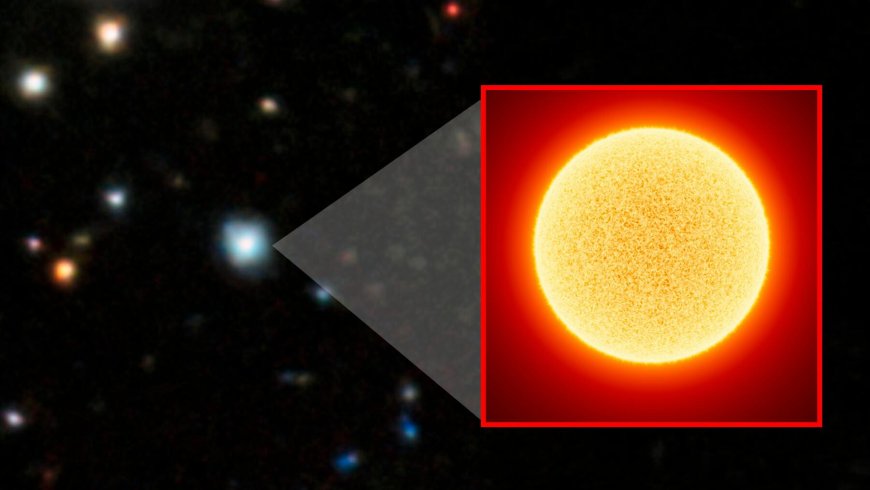
In a tiny, faint dwarf galaxy 150,000 light-years away, astronomers have found a star containing just 1/40,000th of the iron in our sun — the lowest iron abundance ever measured beyond the Milky Way.
The star, designated PicII-503, sits in the ultra-faint dwarf galaxy Pictor II. Researchers describe it as a cosmic fossil: a second-generation star that formed from the debris of the universe’s very first stars, and may still carry their chemical fingerprints intact.
What those fingerprints reveal about how the earliest stars lived and died is now the subject of a new study — and the answer, researchers say, was at the edge of what they thought possible to observe.
A stellar fossil in an unlikely place
PicII-503 was identified through the MAGIC survey — short for Mapping the Ancient Galaxy in CaHK — a dedicated 54-night observing campaign using the Dark Energy Camera (DECam) mounted on the Víctor M. Blanco 4-meter Telescope. The survey had a clear purpose: to find the oldest, most chemically primitive stars in the Milky Way and its dwarf galaxy companions.
Without it, the star would have remained hidden. As team leader Anirudh Chiti of Stanford University noted, isolating PicII-503 among hundreds of other stars near Pictor II would have been impossible without MAGIC’s data. What the survey pulled out was striking: a second-generation star with the lowest iron abundance ever measured beyond the Milky Way, the first confirmed Population II star found in an ultra-faint dwarf galaxy, and the first record of chemical enrichment detected in such a system.
Reading the periodic table of the early universe
To understand why PicII-503 matters, it helps to know how astronomers classify stars by generation. The first stars — Population III, or POP III — formed in a universe containing almost nothing beyond hydrogen and helium. Chemically bare by modern standards.
Those stars forged the first carbon and iron in their cores. When they died in supernova explosions, they seeded the surrounding interstellar medium with these newly created heavy elements. Clouds of gas enriched by that debris eventually cooled and collapsed into the next generation: Population II stars.
POP II stars like PicII-503 function as time capsules — their chemical compositions record what the first stars left behind. Studying them is one of the few ways researchers can access direct evidence of how those earliest, unobservable stars actually lived and died.
Carbon excess, iron deficit: a clue to how the first stars died
The iron deficiency alone would make PicII-503 notable. The star’s carbon abundance adds another layer entirely. Its carbon-to-iron ratio is more than 1,500 times greater than the same ratio in our sun — a striking imbalance that mirrors patterns seen in the lowest-iron stars found in the Milky Way’s outer halo.
The leading explanation involves the nature of the supernovae that ended the first stars’ lives. Those explosions may have been relatively low in energy — powerful enough to eject lighter elements like carbon into the surrounding gas, but too weak to prevent heavier elements like iron from falling back into the stellar remnant. Pictor II’s own characteristics support this. As one of the smallest dwarf galaxies ever observed, it has a correspondingly low gravitational influence, precisely the kind of environment where low-energy supernova dynamics would leave the clearest chemical trace.
Connecting the dots across galaxies
Perhaps the most significant aspect of this discovery is what it links together. PicII-503’s carbon signature doesn’t exist in isolation — it connects directly to patterns already observed in the most metal-poor stars in the Milky Way’s halo, pointing to a shared origin in the same type of first-star enrichment event.
“What excites me the most is that we have observed an outcome of the very initial element production in a primordial galaxy, which is a fundamental observation,” Chiti said. “It also cleanly connects to the signature that we have seen in the lowest-metallicity Milky Way halo stars, tying together their origins and the first-star-enriched nature of these objects.”
The research combined MAGIC survey data with follow-up observations from the Very Large Telescope in Chile and the Baade Magellan Telescope, and was published in Nature Astronomy in March 2025.
What makes this finding durable isn’t just the record it sets, but what it represents across time. PicII-503 formed from the wreckage of stars that no longer exist — stars so ancient they predate every other star we can observe. In its iron-poor, carbon-rich composition, it holds a chemical memory of events that occurred near the beginning of the universe’s history. That a single star in a faint, distant galaxy could preserve that record, and that we now have the tools to read it, is a reminder of how much history remains written in the sky, waiting to be found.
What's Your Reaction?
 Like
0
Like
0
 Dislike
0
Dislike
0
 Love
0
Love
0
 Funny
0
Funny
0
 Angry
0
Angry
0
 Sad
0
Sad
0
 Wow
0
Wow
0