

























Astronaut Charles Duke Left a Family Photo on the Moon During a 1972 Apollo 16 Mission, and It May Still Be There Today!

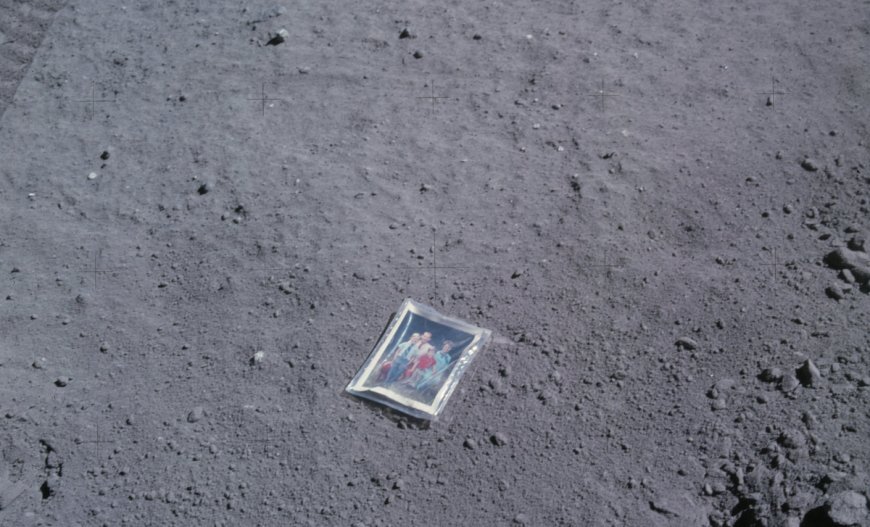
In 1972, during NASA’s Apollo 16 mission, astronaut Charlie Duke left behind more than footprints on the lunar surface, he placed a small, deeply personal object that still rests there today. According to NASA records and mission accounts, this simple family photograph has endured the harsh environment of the Moon for over five decades, becoming a quiet yet powerful symbol of humanity’s presence beyond Earth.
A Personal Gesture Amid a Historic Mission
The Apollo 16 mission marked one of the final chapters of humanity’s first era of lunar exploration, but for Charlie Duke, it carried a meaning that extended beyond science and exploration. Before leaving Earth, Duke wanted to involve his family in a way that would make the mission feel shared, not distant.
As Duke recalled in a 2015 interview,
“Just to get the kids excited about what dad was going to do, I said ‘Would y’all like to go to the moon with me?’ We can take a picture of the family and so the whole family can go to the moon.”
That idea materialized into a small photograph, carefully packed among mission items. Once on the Moon, Duke placed it gently on the surface, ensuring it would remain there as a symbolic extension of his presence, and his family’s, on another world. In the context of a mission driven by technical precision and scientific goals, this gesture stands out as strikingly human.

A Message Preserved in the Vacuum of Space
The photograph itself was not left without context. On its back, Duke wrote a message intended for anyone who might one day find it, or perhaps simply as a record of that moment in time.
He wrote: “This is the family of astronaut Charlie Duke from planet Earth who landed on the moon on April 20, 1972.”
This inscription transforms the photo into more than a keepsake. It becomes a time capsule, a declaration of identity and origin placed on a celestial body millions of miles away. According to NASA mission documentation, the absence of atmosphere on the Moon means the photo has likely remained largely undisturbed, though exposure to extreme temperatures and radiation may have altered its appearance over time.
Enduring the Harsh Reality of the Lunar Surface
The Moon is not a gentle environment. Temperatures swing drastically, ranging from extreme heat during the lunar day to intense cold at night. Radiation constantly bombards the surface due to the lack of atmospheric protection. Under such conditions, most materials degrade quickly.
Yet the photograph remains, at least in place if not in pristine condition. Its survival highlights both the fragility and persistence of human artifacts in space. Unlike flags or equipment designed for durability, this was an ordinary object, never intended to withstand decades on the lunar surface.
Its continued presence raises intriguing questions about preservation in space and the long-term fate of human objects beyond Earth. It also reinforces the idea that even the smallest items can carry immense symbolic weight when placed in extraordinary contexts.

Credit: NASA/ Edited with Canva
A Quiet Legacy of Humanity Beyond Earth
While Apollo missions are often remembered for their technological achievements and geopolitical significance, artifacts like Duke’s family photo reveal another dimension of space exploration. They show how astronauts carried pieces of their personal lives with them, bridging the gap between Earth and the unknown.
More than fifty years later, that photograph remains a silent witness to one of humanity’s greatest endeavors. It does not transmit data or conduct experiments, yet its meaning resonates just as strongly. It represents connection, memory, and the desire to leave a trace of who we are, even in the most distant places.
As future missions aim to return humans to the Moon, objects like this serve as reminders that exploration is not only about discovery, but also about identity and legacy.
Enjoyed this article? Subscribe to our free newsletter for engaging stories, exclusive content, and the latest news.
What's Your Reaction?
 Like
0
Like
0
 Dislike
0
Dislike
0
 Love
0
Love
0
 Funny
0
Funny
0
 Angry
0
Angry
0
 Sad
0
Sad
0
 Wow
0
Wow
0