




























A U.S. Navy Destroyer Vaporizes a Drone Swarm at Sea with a Powerful Laser Beam

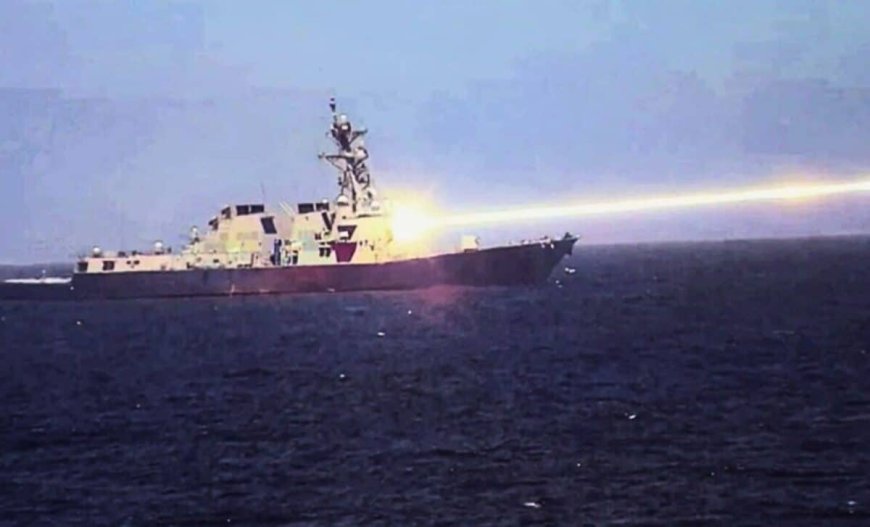
A guided-missile destroyer at sea doesn’t need a missile to show it is ready. In a Navy-run drill, a bright beam came off the deck of USS Preble and held on target long enough to do damage, not just put on a show. The event itself happened in 2025, but it only surfaced publicly in early 2026, after the paperwork caught up with the video.
What makes that timing matter is the setting. The Navy has spent years testing ship lasers in controlled conditions, then moving them to pier-side checks, then to limited at-sea work. This time, the disclosure points to something closer to a frontline workflow, where the ship’s own sensors and combat system are part of the shot chain.
The ship at the center of it is USS Preble, a Flight IIA Arleigh Burke-class destroyer built around the Aegis Combat System. That matters because Aegis is already the ship’s brain for tracking air threats, assigning weapons, and managing engagements. A laser that plugs into that system is not a separate gadget on deck; it is meant to behave like another line on the weapons menu.
The paper trail that finally named the weapon
The public trail runs through Lockheed Martin, not a Navy press conference. The engagement was described in the company’s Q4 2025 financial report, which framed the event as a milestone for a program the Navy has been funding for years. In other words, the moment went public because a quarterly filing needed to explain progress, not because the service wanted a headline.
That filing also supplied the cleanest detail about what happened. The quote attributed to the company’s CEO in the report reads: “The HELIOS weapon system successfully neutralized four drone threats in a US Navy-operated counter-UAS drone demonstration at sea.” The wording is narrow, but it pins down the target type, the scenario, and the count.

Those four targets are the first publicly confirmed airborne takedowns by this specific shipboard laser during a Navy operational demonstration, according to reporting that followed. The drill is described as a sea-based counter-UAS exercise conducted in open water. It is also described as proof that the system has moved beyond lab work and dockside testing into live use on an active combatant.
What HELIOS is built to do on a destroyer
The system itself is HELIOS, short for High Energy Laser with Integrated Optical-dazzler and Surveillance, also identified as Mk 5 Mod 0 HELIOS. It is described as a 60 kilowatt high-energy laser weapon developed by Lockheed Martin to intercept combat drones, fast-attack craft, and missiles. That 60-kilowatt “class” label is important because it signals a family of power levels rather than a single fixed output.
HELIOS is designed to do two different jobs, depending on what the operator needs in the moment. One is a “soft-kill” effect, using an optical dazzler approach to degrade or blind sensors. The other is “hard-kill,” where the beam applies heat long enough to damage structure, not just optics.

The design leans on modularity. The system uses a modular power and fiber-optic configuration that can be expanded to operate between 60 and 120 kW. It also lists long-range surveillance functions, including ISR, alongside the weapon role, which is why the name includes “Surveillance” as well as “Laser.”
Why integration with Aegis changes the drill
The part that keeps coming up in descriptions of HELIOS is integration. Unlike bolt-on systems that sit apart from the ship’s main fire-control loop, HELIOS is designed to live inside the existing Aegis Combat System architecture. That means it can use the ship’s radar and fire-control inputs for detection and targeting, rather than relying on a separate sensor stack.
That approach is often contrasted with ODIN, which has been fielded to multiple destroyers but is described as a dazzler rather than a hard-kill weapon. HELIOS, by contrast, is presented as both dazzler and destructor, and also as a sensor that can generate precise targeting data. That matters in a drone defense scenario, where the tracking problem can be as hard as the shooting problem.

The integration pitch also leans on logistics. A laser shot does not require the ship to load another missile, but it does require power and cooling. The system relies on ship power, which allows repeated engagements without reloads, limited by sustaining power and cooling.
The constraints that follow the beam
Power is not free, even on a destroyer. A specific squeeze shows up on Flight III Arleigh Burke-class destroyers, which need more electrical power for the AN/SPY-6 radar, leaving less margin for extra systems. It even includes a warning from Rear Admiral Ronald Boxall, who said, “The Navy will have to either remove something or look at ‘very aggressive power management.’”
The program also has a long financial runway behind it. The U.S. Navy awarded Lockheed Martin a $150 million contract in 2018 to develop a high-energy laser for countering drones, fast-attack vehicles, and anti-ship missiles, with one unit for land testing and one for installation on a Flight IIA destroyer. The system’s first announced installation was on USS Preble in 2019, which helps explain why the 2025 at-sea demonstration reads like a step in a multi-year ladder, not a sudden debut.
Even the range claims are framed cautiously. Purported advantages include capacity for multiple shots ranging as far as 6 miles (9.66 km), and higher-power lasers in the 150 to 300 kW range are being tested against larger threats such as anti-ship cruise missiles.
The story, in the end, is not just that USS Preble fired a laser. It is that USS Preble did it in a Navy-operated at-sea demonstration tied into the ship’s normal combat system, with results that later showed up in a corporate filing. And the platform at the center of it, USS Preble, was the first announced HELIOS installation in 2019.
Enjoyed this article? Subscribe to our free newsletter for engaging stories, exclusive content, and the latest news.
What's Your Reaction?
 Like
0
Like
0
 Dislike
0
Dislike
0
 Love
0
Love
0
 Funny
0
Funny
0
 Angry
0
Angry
0
 Sad
0
Sad
0
 Wow
0
Wow
0