





























A Spelunker Confused Cave Debris for Trash. It Turned Out to Be Proof of a Long-Vanished Civilization

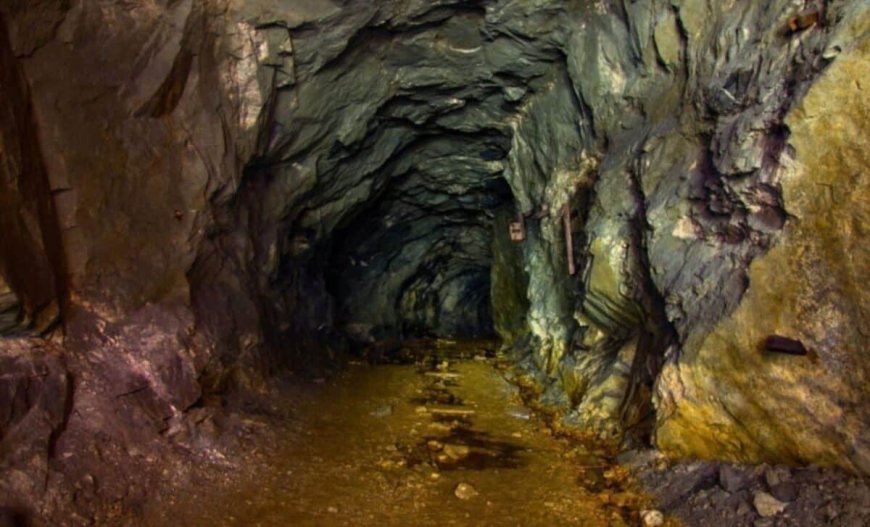
The ceiling was fifteen centimetres above the waterline. To move forward, the explorers had to submerge in the dark and push through. What waited on the other side had not been seen in roughly five hundred years.
In September 2023, Russian speleologist Yekaterina Katiya Pavlova and her local guide Adrián Beltrán Dimas were mapping the cave system of Tlayócoc, set at more than 2,380 metres above sea level in Mexico’s Sierra de Guerrero, when they pressed beyond a known endpoint into flooded, uncharted territory. The secondary chamber they reached held objects arranged on stalagmites with a precision that did not belong to chance. Pavlova’s first instinct was to dismiss them. “We thought it was trash at first,” she later noted in a translated statement. It was not trash.
The objects were pre-Hispanic ritual artefacts. The group that left them there, the Tlacotepehua, has no confirmed archaeological record. Colonial documents from the 16th century place them in the Guerrero highlands, and then they vanish. For researchers trying to reconstruct cultural networks across Postclassic Mesoamerica, a sealed deposit untouched by looters or water intrusion is extraordinarily rare.
Fourteen Objects, One Unbroken Context
The INAH bulletin catalogues fourteen archaeological objects from the Tlayócoc chamber: three carved shell bracelets engraved from Triplofusus giganteus shell, a bracelet fragment, a Strombus sp. marine conch, a 3.2-centimetre piece of carbonised wood, and eight stone discs, two intact and six fragmentary.
Identified motifs include the xonecuilli, an S-shaped symbol tied in Mesoamerican cosmological tradition to the planet Venus and calendrical cycles, alongside zigzag lines, circular forms, and profile faces interpreted as anthropomorphic representations. One face may depict Quetzalcoatl, the creator deity associated with wind and fertility. The stone discs average 9.5 centimetres in diameter with small perforations at their edges, consistent in form with pyrite mirrors documented at other Mesoamerican ritual sites.
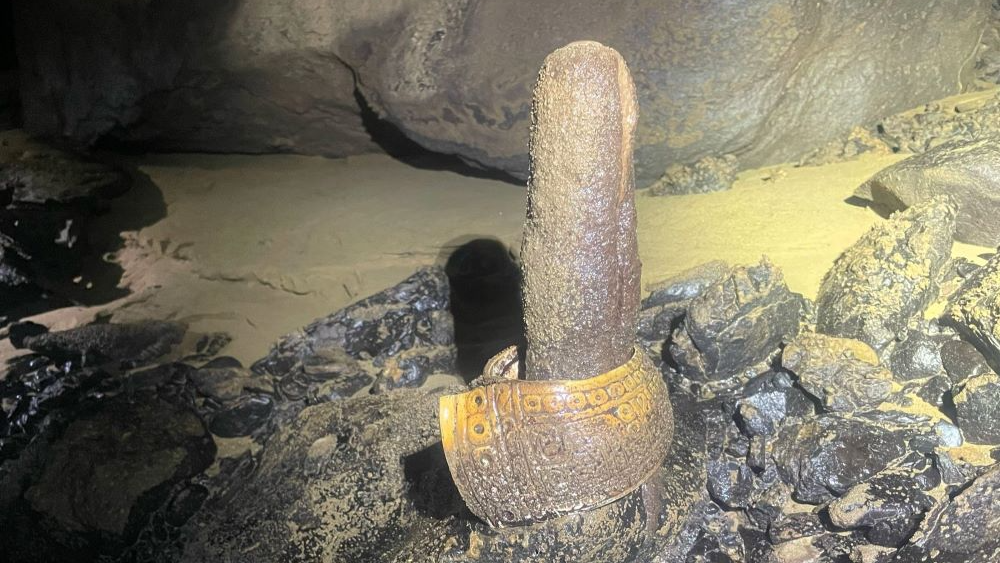
INAH archaeologists found evidence that the stalagmites had been physically modified in pre-Hispanic times into a more spherical, phallic form. The institute’s bulletin frames this spatial arrangement as consistent with fertility rituals in subterranean environments, where caves carried dual symbolic weight as passages to the underworld and as symbolic wombs of the earth. The chamber’s high humidity and stable temperature produced a preservation standard rarely encountered in highland excavation contexts.
The assemblage is dated to the Postclassic period, between A.D. 950 and 1521. Water flow had displaced some disc fragments before the 2024 inspection, complicating a full spatial reconstruction of the original deposit.
A People Known Only from Colonial Documents
The Tlacotepehua appear in 16th-century Spanish colonial sources as an Indigenous group occupying the Guerrero highlands, but no confirmed physical trace of their material culture or ritual practices had been identified in the archaeological record before this deposit.
INAH researchers base the tentative attribution on two independent factors: the geographic match between the cave’s location and the territory assigned to the Tlacotepehua in colonial sources, and the stylistic consistency of the artefacts with objects from known Guerrero sites. The bulletin also notes parallels with finds from El Infiernillo, a cave site in Coahuayutla, and from the Huastec region of Veracruz and San Luís Potosí, several hundred kilometres northeast. The Huastec, a Mayan-affiliated people separate from other Mayan groups, are documented as having incorporated marine symbolism and mirror-like stone objects into ritual contexts.
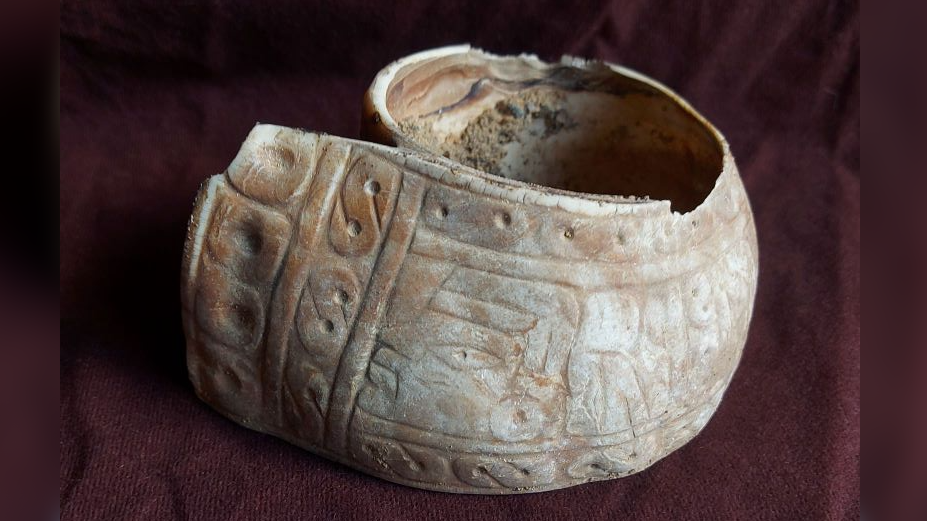
Marine shells at an elevation exceeding 2,380 metres point directly to long-distance exchange networks connecting highland Guerrero communities with coastal and Gulf-region cultures. The stylistic parallels with Huastec material culture do not establish direct cultural affiliation, but they indicate that shared symbolic vocabularies, or active trade routes, extended further into the Mexican interior than current scholarship has mapped.
First Formal Research in Carrizal de Bravo
The community of Carrizal de Bravo sits at 2,397 metres above sea level in the municipality of Leonardo Bravo, surrounded by dense pine and oak forest. Its Nahua-speaking residents are descendants of semi-nomadic herders whose history and culture, the INAH bulletin notes, have been the subject of almost no formal study.
The March 2025 inspection was the first time INAH researchers had visited Carrizal de Bravo. The team included archaeologists Cuauhtémoc Reyes Álvarez and Miguel Pérez Negrete from INAH Guerrero, alongside postgraduate historian Guillermina Valente Ramírez of the Universidad Autónoma de Guerrero. Pavlova’s photographs and cave cartography, shared with the institute’s permission, supplemented the formal record.
The fourteen artefacts, registered in INAH’s national heritage database, remain under the custody of local community authorities. The institute has announced plans for a heritage preservation programme in Carrizal de Bravo and a conservation condition assessment through its Guerrero restoration division, with no timeline published for either.
Conservation Decisions and Outstanding Analysis
No decision has been announced on whether the Tlayócoc artefacts will be extracted for laboratory conservation or kept in place. In-situ preservation exposes them to the cave’s water dynamics, which have already moved disc fragments. Extraction demands navigating the flooded entry passage under controlled conditions, managing the physical stress on fragile shell and stone objects, and overcoming the site’s extreme elevation and geographic isolation.
Further exploration of the Tlayócoc cave system has been suspended pending the formalisation of environmental and cultural safeguards. The carbonised wood fragment has not been submitted for radiocarbon dating, which could narrow the chronological window for the deposit considerably.
As of early 2026, the artefacts remain in community custody in Carrizal de Bravo, the INAH conservation assessment is pending, and the broader Tlayócoc cave system has not been further explored.
Enjoyed this article? Subscribe to our free newsletter for engaging stories, exclusive content, and the latest news.
What's Your Reaction?
 Like
0
Like
0
 Dislike
0
Dislike
0
 Love
0
Love
0
 Funny
0
Funny
0
 Angry
0
Angry
0
 Sad
0
Sad
0
 Wow
0
Wow
0