






















Japanese scientists have created a device capable of converting sweat into electricity, and the idea seems so outlandish that it is hard not to want to find out how it works

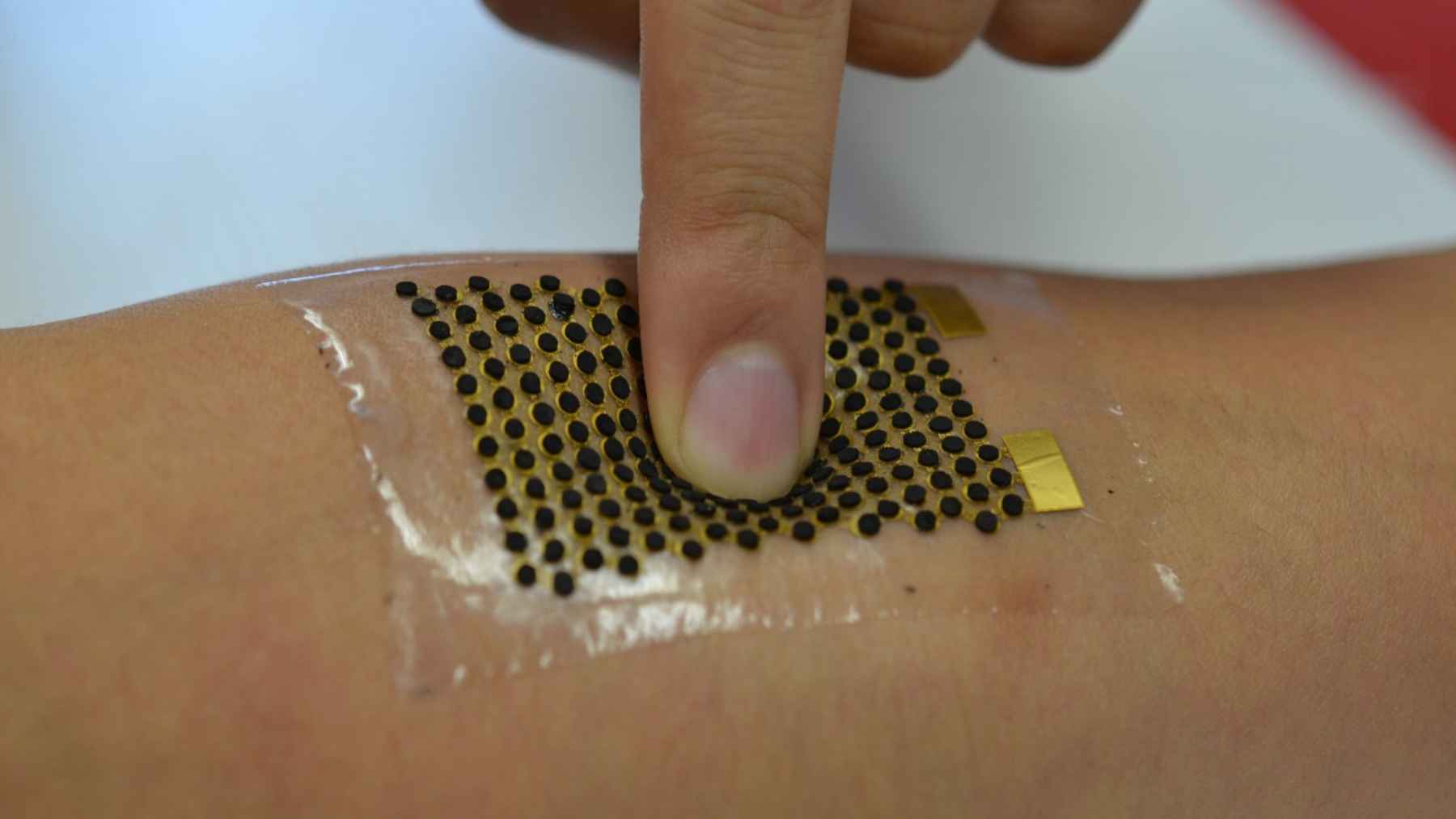
You sweat, it evaporates, and the moment is gone. What if that same sweat could power the patch measuring your workout, without you ever plugging anything in? That is the idea behind a new Japanese study that tries to cut the cord between wearable sensors and their batteries.
A team led by Associate Professor Isao Shitanda at Tokyo University of Science says it has created a water-based “enzyme ink” that can be screen-printed onto paper to make a tiny biofuel cell in a single manufacturing pass.
Co-first author Mahiro Omori and Mitsuru Hanasaki of RESONAC helped develop the approach, and Shitanda said “we need to bring an enzyme ink to the market that can be printed uniformly and is suitable for mass production.”
Why sweat-powered wearables matter
Wearable patches that analyze sweat are appealing because they can track chemistry without needles. But most still need a battery, and that adds bulk, cost, and the everyday hassle of charging.
Researchers have been hunting for alternatives that are thin, flexible, and safe against skin. The goal is modest but useful, which is to get enough energy for sensors and short wireless signals, not to replace a phone battery.
The key concept behind an enzymatic biofuel cell
The device in this study is an enzymatic biofuel cell, sometimes shortened to EBFC. Think of it as a mini power plant that uses enzymes, which are natural “helpers” in biology, to speed up reactions that release electrons.
In this case, the fuel is lactate, a compound that rises in sweat during exercise and can act as a rough signal of effort. The enzyme pulls electrons from lactate at one electrode, those electrons travel through a circuit, and oxygen from the air helps finish the reaction at the other electrode.
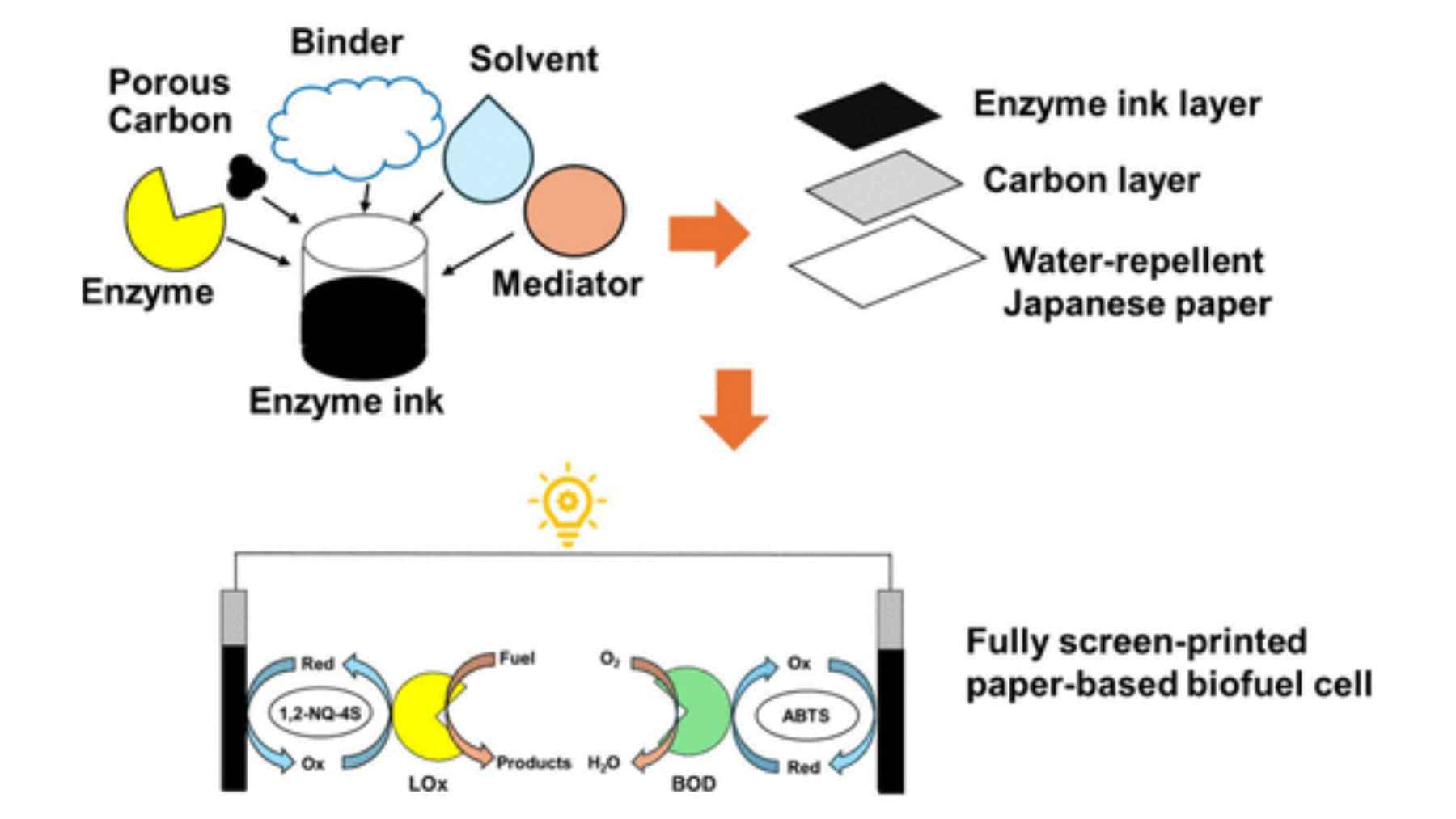
Illustration explains how enzyme ink is used to print a paper-based biofuel cell that converts sweat into usable electricity
The real obstacle was making it at factory-scale
For years, many EBFC prototypes have worked in the lab but stumbled in manufacturing. A common method was to print a carbon layer, then add enzyme solutions drop by drop and wait for them to dry, which can leave uneven coatings.
That unevenness matters because two patches made the same day can produce different power. When a device is meant for health monitoring, consistency is not a nice-to-have – it is the whole game.
What is different about the new “enzyme ink”?
Instead of adding enzymes later, the new approach mixes them into the ink from the start. The formulation uses a very porous carbon material as a scaffold, along with “mediators” that help move electrons, and water-based ingredients that are gentler on fragile enzymes than many organic solvents.
The ink is designed for screen printing, a technique that pushes ink through a mesh onto a surface in repeatable patterns. That matters because the oxygen side of the cell, called the cathode, has been especially hard to print in a stable way, and the team reports this method makes that step workable in one pass.
What the tests found, in everyday terms
Power numbers can sound abstract, so it helps to translate them. Voltage is the “push” that moves electricity, while power density is how much energy you get for a given patch area.
In lab tests, the cell reached 0.63 volts and a peak power density of 165 microwatts per square centimeter, which works out to about 1.1 milliwatts per square inch, and the researchers reported better stability than older drop-cast coatings.
They also said the patch can measure lactate across sweat levels seen during exercise, roughly 1 to 25 millimoles per liter, and showed roll-to-roll printing over about 400 meters, around 1,300 feet, with a potential cost near 10 Japanese yen per patch, or about $0.06 using recent exchange rates near 159 yen to the dollar.
Those figures are still small, but they are in the range that can run low-power sensors and short Bluetooth Low Energy transmissions. No wall charger required, at least in principle.
What still needs to happen before it reaches your wrist
A sweat-powered patch still has to survive real life, including bending, rubbing, and heavy moisture. Paper substrates also need coatings or designs that keep performance steady when sweat rates change, like the difference between a cool evening walk and that sticky summer heat after a hard run.
There is also the question of what the readings really mean for health decisions. Lactate in sweat can track effort for the most part, but it is not a direct blood test, so researchers will need larger studies that connect patch data to clear clinical or training advice.
The idea is not coming out of nowhere. In a 2021 study, the same research group described a paper-based lactate biofuel cell array that generated 3.66 volts and 4.3 milliwatts, enough to run a low-power Bluetooth device in a demonstration.
The main study has been published in ACS Applied Engineering Materials.
What's Your Reaction?
 Like
0
Like
0
 Dislike
0
Dislike
0
 Love
0
Love
0
 Funny
0
Funny
0
 Angry
0
Angry
0
 Sad
0
Sad
0
 Wow
0
Wow
0