





Pompeii home buried by Mount Vesuvius yields personal treasures untouched for nearly 2,000 years

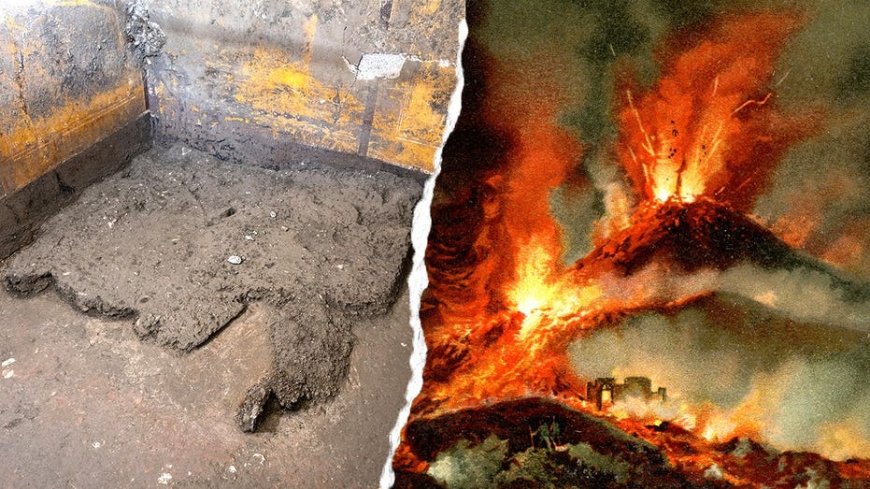
Archaeologists excavating a home in ancient Pompeii recently uncovered the remains of an ancient Roman cabinet — revealing intimate belongings buried for nearly 2,000 years.
The discovery was announced by Pompeii Archaeological Park.
Officials said in a press release in late October, which was translated from Italian, that the cabinet was discovered in house IX 11, 7, also known as the House of Cornelius Maximus, along the Via dell'Abbondanza.
HIDDEN UNDERGROUND CHAMBER REVEALED BENEATH HOME OF LEGENDARY ROMAN EMPEROR
The cabinet — which officials believe belonged to a woman — had apparently remained unopened since Mount Vesuvius erupted in 79 A.D.
Using clues from the excavation, archaeologists were able to determine what the cabinet originally looked like and identify the belongings stored inside.
Pictures released by officials show ancient pottery and other artifacts uncovered during the excavation.
The cabinet contained tweezers, a tool for mixing makeup and a glass perfume bottle, as well as an incense burner, a bronze oil lamp and lead weights.
SUNKEN ROYAL PALACE WITH CLEOPATRA LINK YIELDS RARE FIND TIED TO LONG-LOST WONDER OF ANCIENT WORLD
Among the discoveries was a necklace made up of at least 24 miniature charms, including depictions of gods, hands, feet, pine cones and bunches of grapes.
Such necklaces, known as crepundia, were given to Roman children as protective amulets.
They also made noise as children moved, which allowed adults to hear them.
Officials believe the owner may have retained the necklace as a childhood keepsake.
"Adults sometimes kept these objects, often in small boxes or, as in this case, in cloth bags inside cabinets, evidently as reminders of a childhood of which little else sometimes remained," officials said.
ANCIENT BURIAL REVEALS RARE JEWELRY FIND THAT ARCHAEOLOGISTS CALL 'HIGHLY UNUSUAL'
Archaeologists also discovered a small hoard of 38 bronze coins, though the denominations were not specified, leaving their monetary value unclear.
"The presence of the coins, in particular, suggests that the female owner or owners did not have time to retrieve their possessions of economic or sentimental value," officials said.
The inhabitants of the residence may have fled during the eruption but never returned to recover their belongings, unlike others who apparently returned to dig for their possessions, according to evidence from recent excavations.
"But perhaps they did not survive. ... These are questions destined to remain unanswered," the release added.
CLICK HERE TO SIGN UP FOR OUR LIFESTYLE NEWSLETTER
Gabriel Zuchtriegel, director of Pompeii Archaeological Park, said in a statement that the objects found at the excavation site "bring the human dimension of the past back to life."
Said Zuchtriegel, "We cannot reconstruct with certainty the identity of those who lived in the house, but these fragments bring us closer to their everyday lives."
The excavation also revealed elaborate wall paintings inside the home, suggesting its residents were relatively well-off.
CLICK HERE FOR MORE LIFESTYLE NEWS
Construction work was underway when Mount Vesuvius erupted, however, which may have disrupted daily life in the home.
Archaeologists also found the skeletons of at least two young mice inside a storage vessel on a mezzanine level.
The mice were likely wood mice, which commonly make their way into homes looking for food — a reminder that ancient Romans dealt with unwanted household pests, much like people today.
TEST YOURSELF WITH OUR LATEST LIFESTYLE QUIZ
The find is one of many discoveries made at Pompeii in recent years.
Earlier this year, archaeologists uncovered 2,000-year-old love notes etched into a wall, using advanced imaging technology to reveal inscriptions that had long gone unnoticed.
Last year, archaeologists found the remains of at least four people, including a child, in a Pompeii home where residents had tried to shield themselves from the eruption by barricading a door with a bed.
What's Your Reaction?
 Like
0
 Dislike
0
 Love
0
 Funny
0
 Angry
0
 Sad
0
 Wow
0