




























JWST Spots a Fully Formed Dusty Galaxy Just 400 Million Years After the Big Bang

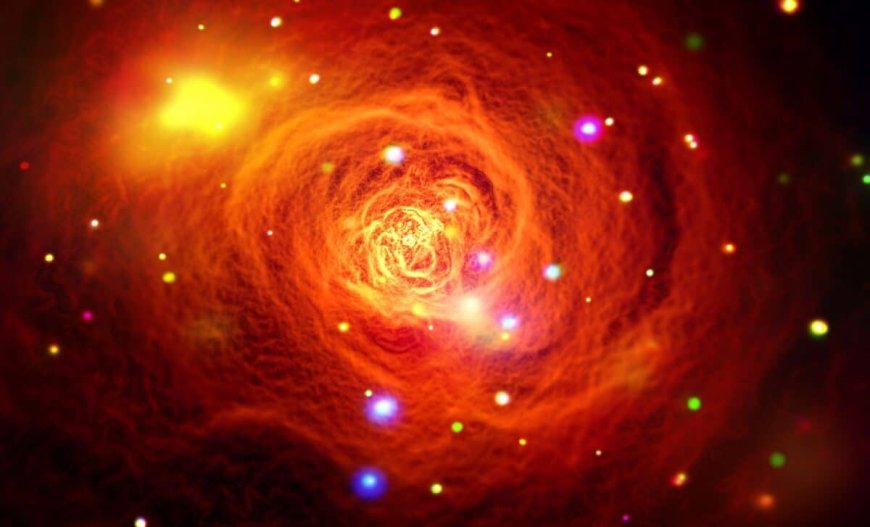
A massive, dust-packed galaxy seen just 400 million years after the big bang is leaving astronomers scratching their heads. Called EGS-z11-R0, it looks far more evolved than anything expected at that stage of cosmic history, almost as if it had far more time to grow and transform than the universe actually allowed.
Spotted with NASA’s James Webb Space Telescope (JWST), the object is already stirring debate. Its size and composition do not quite fit with current models of how fast galaxies are supposed to grow, especially at such an early epoch when the first structures were only beginning to take shape.
The discovery comes from a sweep through public JWST data, where researchers searched for hidden, dust-obscured systems among previously identified galaxies. The team led by Giulia Rodighiero found only one clear match, this unusually red and massive object. That alone makes it notable, suggesting that such galaxies are either extremely rare or simply very difficult to detect with current methods.
A Galaxy Loaded With Dust Far Too Early
EGS-z11-R0 galaxy gets its deep red color from thick clouds of dust that absorb blue light from young stars. That effect shows up clearly in its ultraviolet light profile, which appears flatter than expected.
Dust like this usually takes time to build up, forming through multiple generations of stars. Pieter van Dokkum, an astrophysicist at Yale University, calls the short timeline “astonishing,” pointing out that comparable timescales exist in the evolution of long-lived species like sharks and turtles.
Signs Of A Surprisingly Mature System
As stated by a preprint study, the team also detected carbon in the galaxy’s spectrum, another marker of advanced evolution. Carbon formsinside stars and spreads through explosive events like supernovae, meaning several stellar cycles must have already taken place.
That is what makes this object so puzzling. You do not just get dust and carbon overnight. The presence of both suggests that EGS-z11-R0 has already lived through intense periods of star formation and destruction, much earlier than expected.
Red And Blue Monsters Different Stages Of The Same Story
This galaxy is part of a growing group spotted by JWST, sometimes nicknamed “monster galaxies.” These objects stand out because of their extreme properties, whether it is their mass, brightness, or level of evolution at such early cosmic times. Some are described as “blue,” meaning they shine brightly with little dust and are dominated by young, hot stars. Others, like this one, appear heavily reddened, their light filtered and dimmed by thick layers of dust.
“We think that they are connected by the same evolutionary story.” she added that: “It’s just that we catch galaxies in different periods,” said Giulia Rodighiero. She also notes that blue galaxies are simply easier to detect, which could skew what we see.

At this stage, EGS-z11-R0 appears to be an outlier, standing apart even among the unusual galaxies uncovered by the Webb Telescope. Its combination of mass, dust content, and early appearance makes it difficult to place within existing categories, which is why it draws so much attention.
“Future JWST spectroscopy and deeper mid-infrared, submillimeter and radio observations will be crucial to establish the prevalence of these early dust-rich galaxies and to clarify their role in the earliest phases of galaxy and black-hole growth,” said the researchers.
Enjoyed this article? Subscribe to our free newsletter for engaging stories, exclusive content, and the latest news.
What's Your Reaction?
 Like
0
Like
0
 Dislike
0
Dislike
0
 Love
0
Love
0
 Funny
0
Funny
0
 Angry
0
Angry
0
 Sad
0
Sad
0
 Wow
0
Wow
0