


























CERN has detected a particle similar to a proton, but about four times heavier, and so rare that detecting it has been much more complicated than it seems

What if you could take a proton, keep its basic three-part structure, and then swap in heavier building blocks? Physicists working with the Large Hadron Collider say they have now observed a rare particle called Xi-cc-plus that is about four times heavier than a proton and far less common.
The result was presented in March 2026 at the Rencontres de Moriond conference, using collision data recorded in 2024. Researchers say it is the first brand-new particle spotted with the upgraded LHCb detector, and it pushes the running total of hadrons discovered at the collider’s experiments to 80.
A proton-like particle with heavier parts
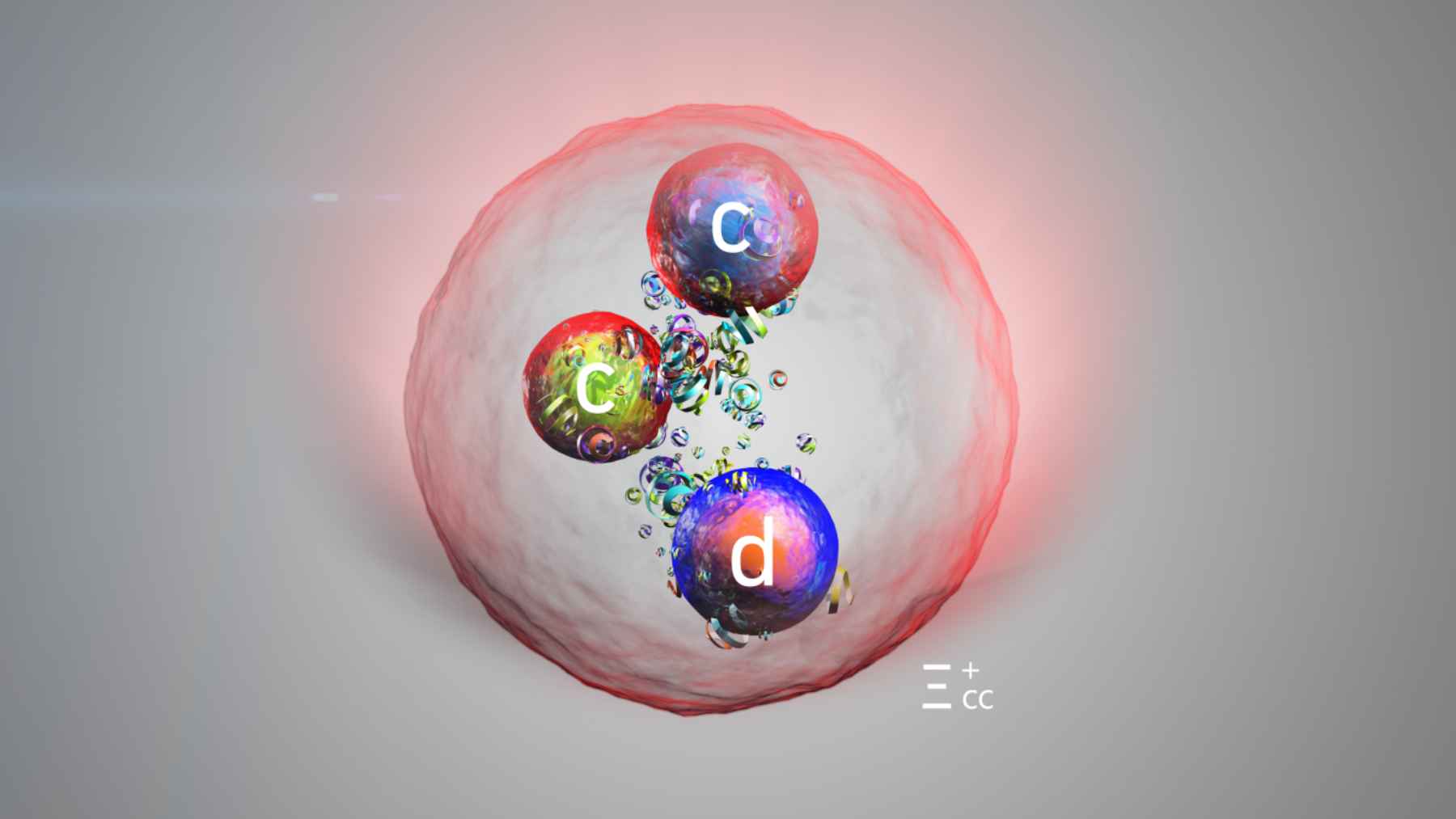
Xi-cc-plus is a type of particle called a baryon, meaning it is built from three quarks. Its recipe is two heavy charm quarks plus one down quark, while a proton uses two up quarks plus one down quark. With charm quarks doing the heavy lifting, the particle ends up roughly four times heavier than a proton, according to the official news release.
It is also unstable. If it were sitting still, researchers estimate it would last about 45 femtoseconds, which is 45 millionths of a billionth of a second, before breaking apart. Short life, rare production, and a noisy collision environment make it a tough target.
Quarks and hadrons in plain English
Quarks are some of the smallest known pieces of matter, and they come in six “flavors” such as up, down, and charm. They do not usually travel alone, because the strong force locks them into groups called hadrons. The two big hadron families are mesons, made of two quarks, and baryons, made of three.
Protons and neutrons are the baryons you meet in every chemistry class, since they sit in the nucleus of atoms. But high-energy collisions can briefly produce stranger combinations that do not exist for long in nature. Studying them is a way to check whether the same rules still work.
How scientists spotted the signal
A collider does not let you “see” Xi-cc-plus directly. Instead, the particle decays into other particles that leave tracks in the detector, and scientists work backward from those tracks.
In this case, researchers reconstructed Xi-cc-plus from a decay chain that included a known “Lambda-c” baryon along with a kaon and a pion. A partner laboratory report says the team identified 915 candidate decay events, enough to form a clear bump in the data above background noise in the summary. That bump is the calling card of a new particle.
Statistics are the guardrails. The team reported a seven-sigma significance, well beyond the five-sigma bar typically required before using the word “discovery.” In everyday terms, they consider it extremely unlikely to be a fluke.
Why the detector upgrade mattered
The upgraded setup was completed in 2023 and was built to handle many more collision events without losing precision. One key change was a faster software-based selection system that decides which events to keep, instead of throwing them away early. More saved events means more chances for rare decays to show up.
Some of the hardware work behind the upgrade is described in a 2023 detector note. It explains how new tracking components were installed close to the beamline to better measure the paths of particles. For researchers, that added detail can turn a faint hint into a measurable signal.
Ao Xu of Scuola Normale Superiore said the team is “opening a new window onto a very unusual form of matter.” Better sensitivity lets them explore particles that were previously on the edge of being observable.
The missing sibling from 2017
This discovery completes a pair that theorists have long expected. In 2017, the experiment reported Xi-cc-plus-plus, a very similar particle that differs mainly by having an up quark where Xi-cc-plus has a down quark, as described in a July 2017 announcement. The new result fills in the missing partner.
The new particle was predicted to be harder to find because it should live much less long, by as much as six times, due to subtle quantum effects inside the particle. A shorter lifetime can leave fewer clean tracks, which makes background noise harder to beat. That is where the upgraded detector and the larger modern dataset came in.
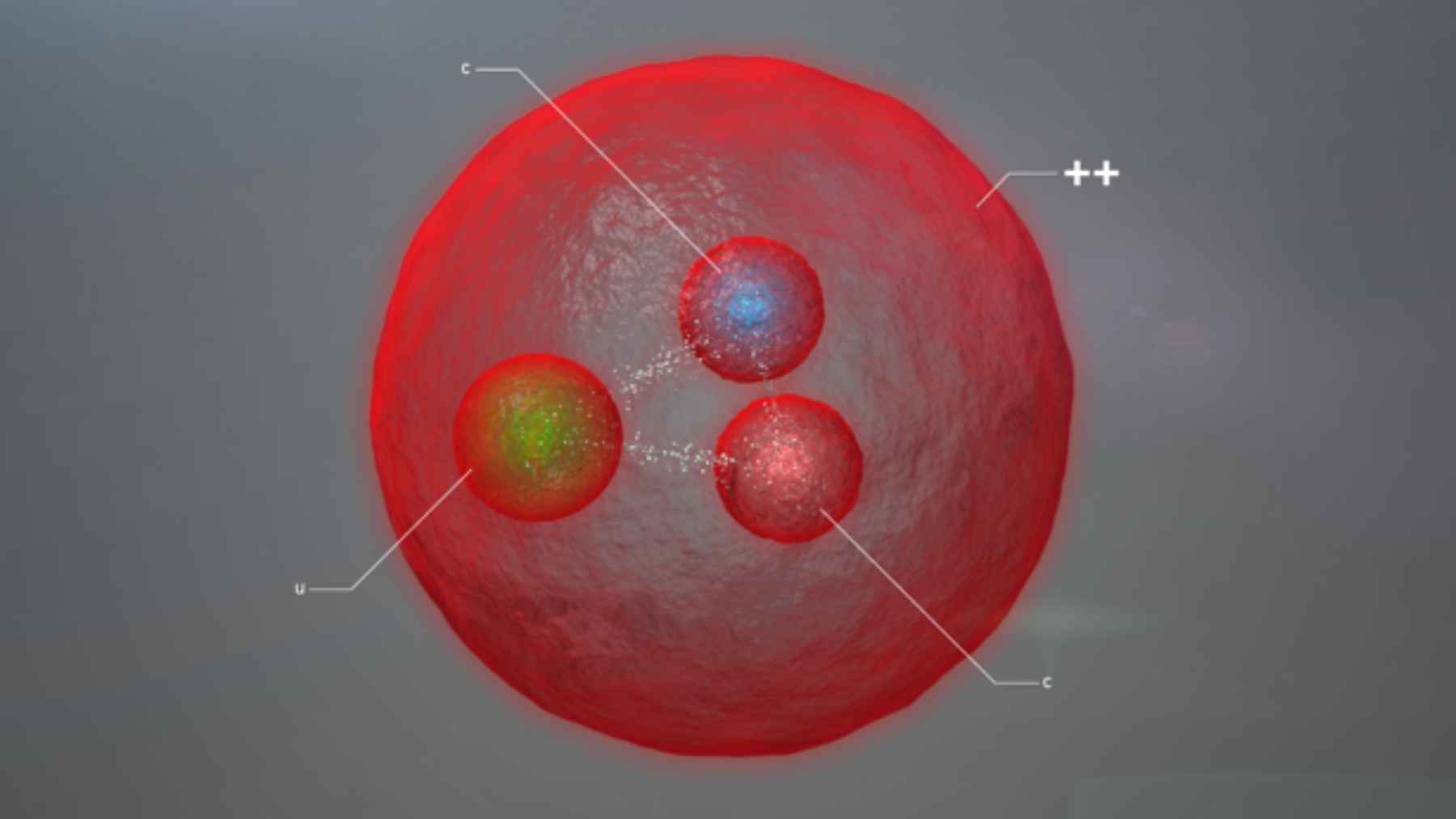
Subatomic recipe: The Xi-cc-plus baryon is composed of two heavy charm quarks (c) and one down quark (u), making it four times heavier than a proton.
What this discovery is good for
The deeper goal is to test quantum chromodynamics, the theory that describes the strong force. It is hard to calculate in the conditions that actually make hadrons, so experimental benchmarks are valuable. Xi-cc-plus is useful because it mixes two heavy quarks with one light quark, giving theorists a cleaner comparison point than many other short-lived particles.
Spokesperson Vincenzo Vagnoni called it “the first new particle identified after the upgrades,” tying the milestone directly to the new detector’s capabilities. The detailed analysis is available as a preprint that documents how the signal was extracted from the 2024 dataset.
There is also a connection to “exotic” hadrons such as tetraquarks and pentaquarks, which bundle quarks in less familiar ways. A 2025 report on tetraquark research explains how mapping these particles can sharpen our understanding of the same force that builds ordinary matter.
What happens next
Researchers say they are already looking for an even heavier cousin, one that adds a strange quark to the mix. A strange quark is still a basic building block, just heavier than up and down quarks, and it can change how the particle decays. Finding that state would provide another demanding test for theory.
Giovanni Punzi said teams from the Istituto Nazionale di Fisica Nucleare, representing nearly one-fifth of the collaboration, helped upgrade the detector and analyze the data, and he pointed to plans for another upgrade aimed at boosting collision intensity fivefold.
More collisions mean more rare particles, and more chances to learn how quarks behave when the strong force is pushed to its limits.
The main press release has been published by CERN.
What's Your Reaction?
 Like
0
Like
0
 Dislike
0
Dislike
0
 Love
0
Love
0
 Funny
0
Funny
0
 Angry
0
Angry
0
 Sad
0
Sad
0
 Wow
0
Wow
0