


























Archaeologists Found a Skeleton of a Man Frozen While Fleeing Vesuvius, Now AI Reveals What He Looked Like 2,000 Years Later

A man who died during the eruption of Mount Vesuvius in AD 79 has been digitally reconstructed using artificial intelligence. The project offers a new way to visualize the victims of Pompeii while staying grounded in archaeological evidence. It connects scientific data with a more immediate human perspective.
The reconstruction was carried out by the Pompeii Archaeological Park in collaboration with the University of Padua. According to the official announcement, it is the first time AI has been used at the site to create a digital portrait based on excavation data.
Pompeii, located near Naples and listed as a UNESCO World Heritage site, was buried under ash and pumice nearly 2,000 years ago. The eruption preserved the city and thousands of its inhabitants.
A Man Caught In The Early Phase Of The Eruption
The reconstructed individual was discovered near Porta Stabia, just outside the ancient city walls. As mention in the press release published by the Pompeii Archaeological Park, he appeared to be trying to flee toward the coast when he was overtaken by the eruption.
Researchers believe he died early in the event during a heavy fall of volcanic debris. His remains were found alongside another person, suggesting that multiple individuals were attempting to escape through the same route. The position of the body and surrounding materials point to a rapid and chaotic situation.

The digital image shows the man running along a debris-covered road, with Mount Vesuvius erupting in the background.
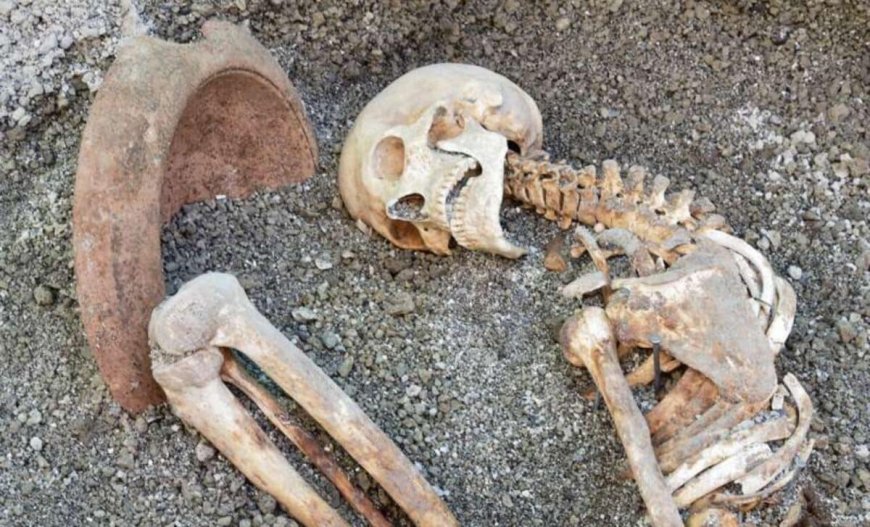
“One of them, the younger one, was likely swept away by a pyroclastic flow – a glowing cloud of ash and toxic gases – while trying to flee the city. The other, the older man, died a few hours earlier under a shower of lapilli, trying to protect his head with a terracotta mortar found near his body, showing clear signs of fracture,” wrote the authors in the statement.
Items Recovered from the Deceased
Several personal items were recovered with the man. These included an oil lamp, a small iron ring, and ten bronze coins. These objects reflect aspects of everyday life in Pompeii and provide context for the individual’s final moments.
One object stands out in particular. Archaeologists found a terracotta mortar that the man was holding. As explained by the researchers, it was likely used as a form of protection against falling volcanic stones.

For Pliny the Younger, who documented the eruption, residents used available objects to shield themselves as ash and debris fell across the city. The archaeological evidence aligns with these written accounts.
Using AI to Decode Archaeological Data
The reconstruction was created using AI and photo editing techniques designed to transform skeletal remains into a realistic human face. As reported by the official institutional portal, this method relies on detailed survey data collected during excavations near the Porta Stabia necropolis.
Park director Gabriel Zuchtriegel stated that the growing need for advanced tools to handle the scale of archaeological data.
“The scale of archaeological data at Pompeii and beyond is so vast that only artificial intelligence can truly help us preserve and enhance it,” said Director Zuchtriegel. “When used effectively, AI can revitalize classical studies by offering a more immersive understanding of the ancient world.”
The project also seeks to make archaeological research more accessible to the public. By pairing a human face with scientific data, researchers provide a more direct way to engage with the history of Pompeii while remaining grounded in evidence.
Enjoyed this article? Subscribe to our free newsletter for engaging stories, exclusive content, and the latest news.
What's Your Reaction?
 Like
0
Like
0
 Dislike
0
Dislike
0
 Love
0
Love
0
 Funny
0
Funny
0
 Angry
0
Angry
0
 Sad
0
Sad
0
 Wow
0
Wow
0