




























A Japanese study finally explains in detail how cats almost always land on their feet, and the secret lies in a very specific, flexible part of their spine

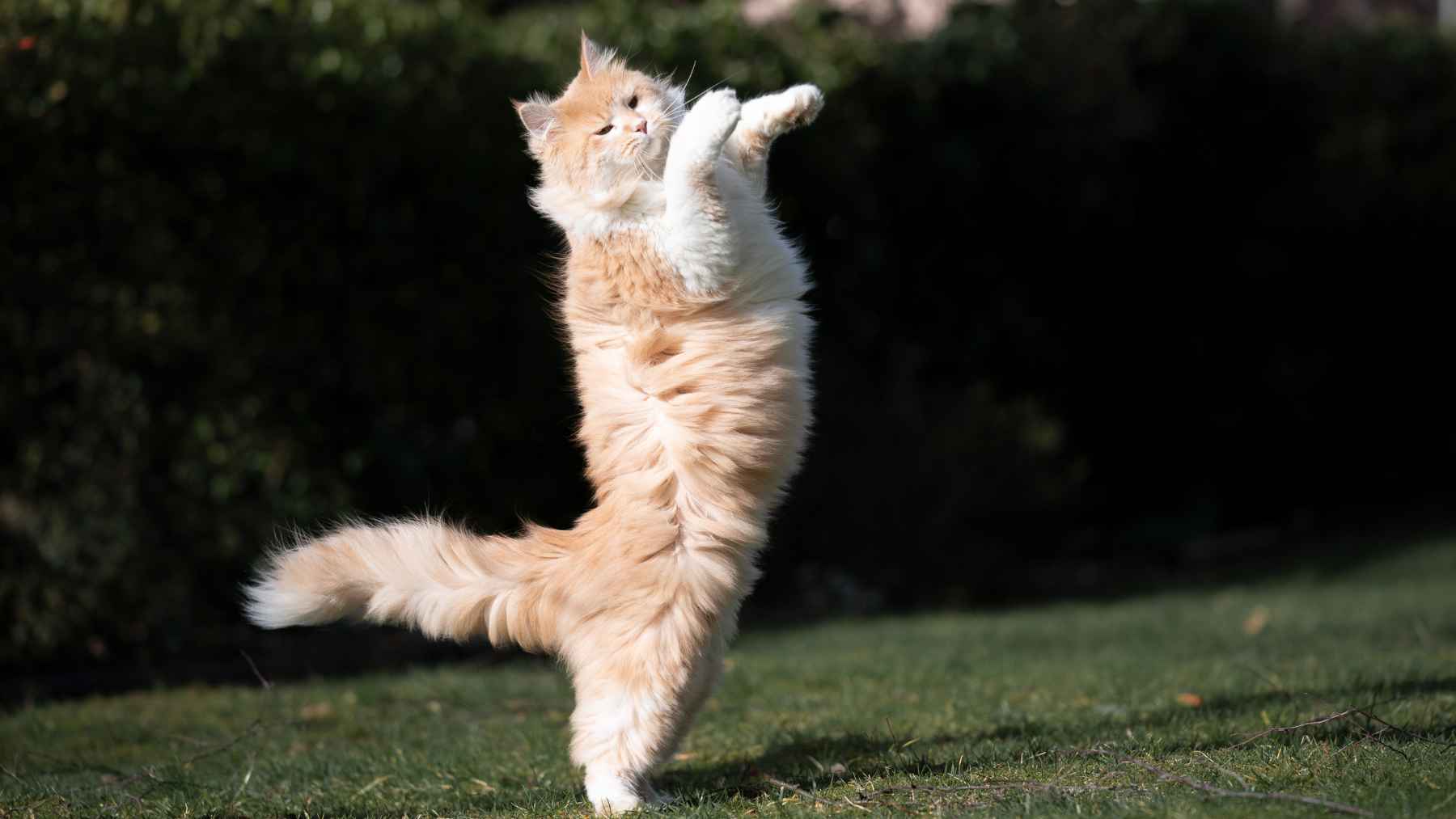
You know that heart-stopping moment when a cat slips off a windowsill and you brace for the worst, only to see four paws meet the floor like it was planned? Researchers in Japan say that near-perfect landing is not luck or “magic” but a mechanical advantage built into then feline spine.
So how does a falling animal turn without pushing off anything? A new Yamaguchi University study, published February 24, 2026, suggests the answer is a back that is flexible in the front and stiff in the rear, letting cats rotate in a controlled sequence while still playing by the rules of physics.
A spine built for two jobs
The researchers found a big mismatch between the thoracic spine (upper and middle back) and the lumbar spine (lower back). In mechanical tests, the thoracic region had a “neutral zone” of about 47° where it could twist with very little resistance, while the lumbar region had no neutral zone at all.
That split personality is the whole trick. The thoracic section can “steer” the front half into position, while the stiffer lumbar section acts more like a stabilizer that helps keep the rear from whipping around unpredictably.
There was a trade-off, too, and it feels very real-world. The thoracic region showed lower maximum torque in the lab, meaning it was less resistant to failure under twisting than the lumbar spine, which fits with the idea that flexibility often comes at the cost of strength.
What the team actually tested
To move past slow-motion anecdotes, the team gathered quantitative data. They performed destructive failure testing on the spines of five cat cadavers, measuring maximum torque, stiffness, range of motion, and related properties in the thoracic and lumbar regions separately.
They then looked at real movement, analyzing trunk rotation in two live cats filmed with high-speed cameras as the animals dropped onto a soft cushion. In Phys.org’s reporting, the researchers used tracking markers to follow how the shoulders and hips shifted during the righting maneuver.
Why this does not break physics
The “falling cat problem” has fascinated scientists since the late 1800s because an object in free fall cannot simply start spinning without an external shove. As early as 1894, high-speed photo sequences showed cats gaining rotation after release, which made it clear the trick had to come from changing body shape rather than pushing off a hand or a ledge.
A cat is not a rigid cylinder, and that is the loophole. By bending and twisting different segments at different times, it can reorient itself while conserving angular momentum, and the new study adds a concrete anatomical reason for why the front can rotate first and the rear can “follow” without the whole body counter-rotating wildly.
In the paper’s measurements of real motion, the timing mattered as much as the twist. The anterior trunk completed its rotation earlier than the posterior trunk, reinforcing the idea that cats do this as a step-by-step maneuver rather than one smooth spin.
What it could mean for veterinary care
The authors note that their measurements could help veterinarians think more precisely about spinal injuries and mobility issues. A thoracic section designed for torsion is not the same as a lumbar section built to brace, and that difference may matter when assessing trauma or planning rehabilitation. (pubmed.ncbi.nlm.nih.gov)
But here is the sobering part for cat owners. The ASPCA warns that falls can still cause severe injuries, and shorter falls may be especially risky because cats have less time to fully adjust posture, even if they land feet-first.
If a fall does happen, experts treat it like an emergency, not a “walk it off” moment. The ASPCA notes that with immediate and proper medical attention, cats injured in these falls can have about a 90% survival rate, which is encouraging but also a reminder that time matters.
Bioinspired robots with an environmental angle
The study’s implications go beyond pet trivia, and even the researchers point that out. They suggest the work could improve mathematical models of animal movement and inform the design of more agile robots, especially machines that need to recover from slips and awkward tumbles.
In practical terms, that matters in messy real-world environments where heavy equipment is noisy, fuel-hungry, and sometimes too clumsy for tight spaces.
If engineers can borrow the cat’s “flexible front, stable back” strategy, future robots used for inspections, disaster response, or environmental monitoring could do more with less energy, although turning biology into hardware is rarely a straight line.
What to keep in mind at home and in the lab
This study looked at a small number of animals, so follow-up work will likely ask how consistent these spine properties are across ages, body sizes, and health histories. It may also dig deeper into the timing cues from muscles and the vestibular system in the inner ear, since bones alone do not run the show.
For the rest of us, the takeaway is simple. Cats’ graceful landings come from a finely tuned body plan, but prevention still beats emergency care, so screens, secure balconies, and a quick check before you crack open a window can make a real difference.
The study was published in The Anatomical Record.
What's Your Reaction?
 Like
0
Like
0
 Dislike
0
Dislike
0
 Love
0
Love
0
 Funny
0
Funny
0
 Angry
0
Angry
0
 Sad
0
Sad
0
 Wow
0
Wow
0